Last updated 2026-08-21
TL;DR
Kiln firewood is split wood dried in a heated kiln, usually to 20% moisture or less, which is EPA's seasoned-wood line. Starting is local paper (zoning, tax, weights and measures), not a federal kiln license. Heat-treat certificates are separate from drying. Confirm plant-movement rules with the destination state, because the federal emerald ash borer quarantine is gone.
What is kiln firewood?
Kiln firewood is split wood that was dried in a heated chamber until the moisture is low enough to burn clean. EPA Burn Wise puts that line at 20% moisture or less for seasoned firewood. [1] The kiln is equipment. The product is still firewood.
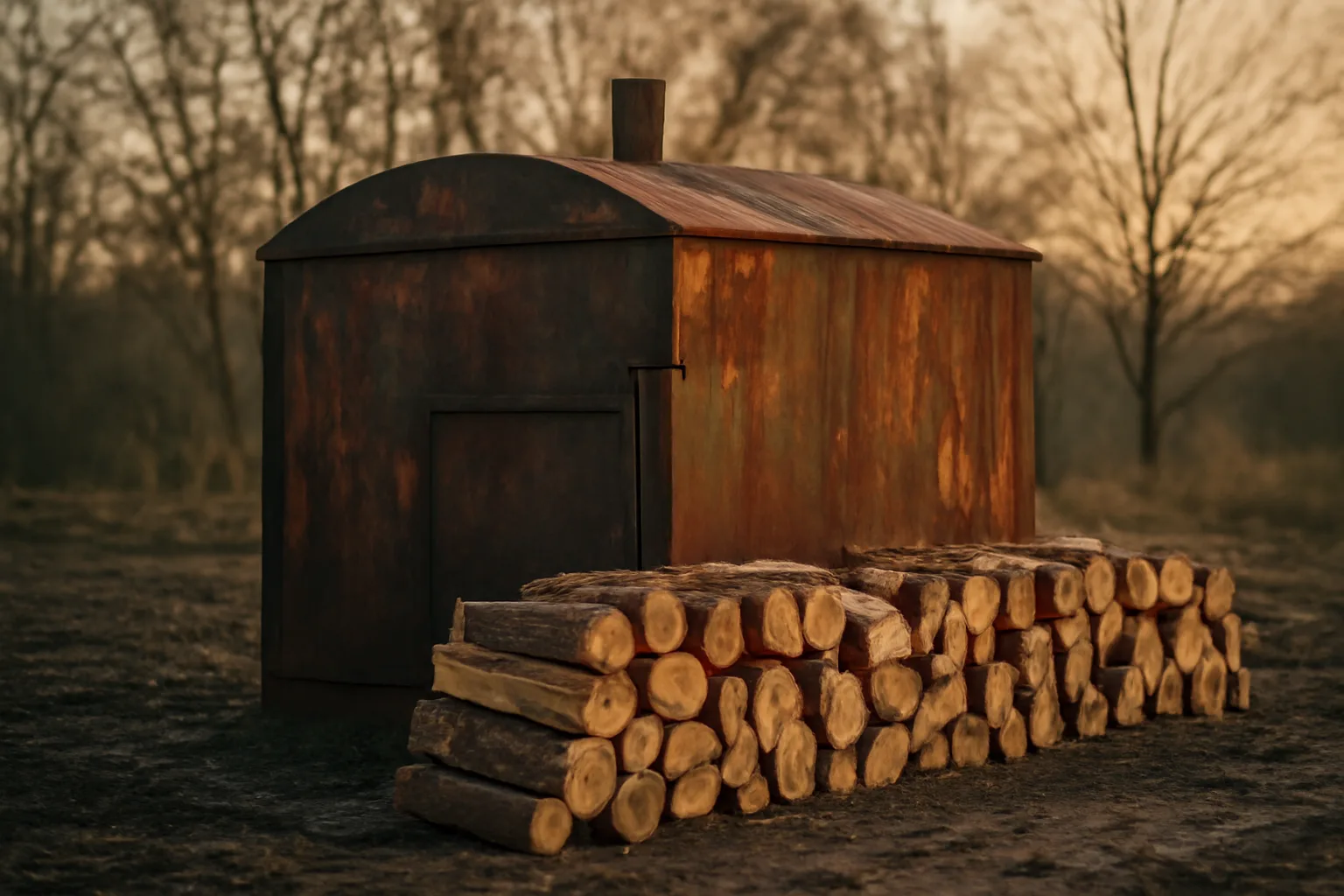
A kiln is a box you can heat and vent. People use converted shipping containers, dehumidification boxes, and leftover lumber dry kilns. Heat drives water out of the cells. Fans pull wet air off the pile. You are not turning the load into charcoal. You are evaporating water on purpose.
Green wood is wetter than most new sellers think. USDA's Forest Products Laboratory measures moisture as water weight against oven-dry wood weight, and green wood can run from about 30% to more than 200% on that scale. [3] "The moisture content of wood is a measure of the water contained in the wood and is expressed as a percentage of the oven-dry weight of the wood." [3] That lab sentence is why two people can say "50% moisture" and still argue.
Kiln firewood sells because it lights in a wet week, it is lighter per truck than a green cord, and it makes less smoke. EPA flags wet wood for extra smoke and creosote. [1][2] Air-dried stacks can hit the same moisture. They just take months, and the center of a fat round can lag. I'd air-dry when I have yard space and a season. I'd kiln when I need inventory this month, or when a buyer wrote kiln-dried into a house rule.
Three products get mixed up in ads. Seasoned firewood sat in the air. Kiln-dried firewood was heated until dry. Heat-treated firewood hit a published core temperature for a published time. You can have one, two, or all three in the same pile. Customers rarely split those hairs. Inspectors do, if you cross a state line or a park gate.
How dry does kiln firewood need to be?
Sell kiln firewood at 20% moisture or less if you want to match EPA's seasoned-wood line. [1] That is a burn-quality number, not a federal kiln license. I have not found a U.S. statute that says kiln firewood must be 12%. If someone quotes a magic retail number, ask for the code section.
FPL's green-wood range (about 30% on the low end, over 200% on the high end) is why a fresh cord and a kiln cord do not weigh the same. [3] Water is heavy. Buyers feel it on the lift and on the chimney.
I meter a sample from the middle of the load, on a fresh split, and I keep a log. Ends lie. Bark lies. A cheap pin meter is enough for yard work. Oven-dry tests are the handbook reference. [3] You will not oven-dry every retail bundle.
Going to 8% looks sharp in photos. It can also mean the wood grabs shed humidity overnight and your label is wrong by morning. I stop in the mid-teens unless a contract says otherwise. Nobody has good field data on the "best" retail moisture for every species and stove. The closest public line you can defend to a household buyer is EPA's 20%. [1][2]
If a buyer or an HOA wants proof, a meter reading plus a date on the kiln batch beats the word kiln on a marketplace ad. Sample more than one stick. Write the numbers down.
Is kiln-dried firewood the same as heat-treated firewood?
No. Kiln-dried means you removed water. Heat-treated means the core of the piece hit a published temperature for a published time. Those can happen in the same kiln. They often don't.
Pest rules for most domestic firewood moves are state rules now. Removing the domestic quarantine regulations for the emerald ash borer was the point of the December 15, 2020 Federal Register final rule. [5] The national EAB map is not your permit. New York still publishes firewood movement limits. [6] Wisconsin still limits what you can bring onto DNR land. [7] California still runs a firewood pest page. [12]
If a park or a state plant board asks for heat treatment, they mean a schedule, probes in the core, and usually a certificate. Drying to 18% does not automatically equal that schedule. Don't print USDA certified on a bag because the container got warm.
I'd run moisture for every retail load. I'd run a documented heat-treat cycle only when a destination board or a land manager requires it. Confirm the current schedule with that board. Schedules change. Random blogs don't.
This is the national myth that wastes a first-year budget: that kiln firewood is already a federal phytosanitary product. Drying is a moisture claim. Treatment is a pest claim. Sell the one you can prove.
How do you start kiln firewood?
You start kiln firewood as a local business that sells a measured commodity, not as a federal timber franchise. Register the business with your state, get a sales tax permit if your state taxes firewood, check county zoning for commercial drying and truck traffic, then call weights and measures before you advertise a cord. [10][11] There is no national kiln firewood license.
SBA's business guide is dry and correct. Licenses sit at state and local offices, not in one federal mailbox. [10] I'd do zoning first. A kiln is a heat source with a fan. Neighbors hear it. HOAs smell smoke if you run a wood-fired box. Get the land-use answer in writing.
Then source wood (your land, a logger, urban take-downs). Then split. Then kiln. Then meter. Then stack off the ground. Then sell by a legal unit. Penn State still has to remind people that wet wood is a combustion problem, not a branding problem. [8] Minnesota Extension's storage pages make the same boring point: dry wood has to stay dry. [13]
Paper you actually need in year one is short. Business registration. A tax ID. Local zoning or home-occupation sign-off. A sales tax permit if required. A plan for cord measure. Whatever your state plant board says about moving wood. If you only sell inside one county, plant paperwork is often lighter. Confirm. Don't guess from a group chat.
I would not wait for a kiln catalog to "approve" you. Order the land question, then the tax question, then the unit-of-sale question. Equipment is third, not first.
What licenses and permits do you actually need?
You need the licenses your county and state already use for small makers and commodity sellers. That usually means a business license, a sales tax account, and a weights and measures conversation if you sell by the cord. [10][11] You do not need a special kiln firewood board. One does not exist.
Plant boards matter when wood moves. New York's firewood rules are a real gate. [6] California's CDFA firewood page is another. [12] Wisconsin's DNR rule is about state land, which still catches vendors who supply campgrounds. [7] Ask the destination, not the origin, if you deliver. Confirm forms and any fee with that board. I will not invent a current fee or processing time.
Air permits are the sleeper issue. A small electric or propane kiln on agricultural land may be nothing. A big wood-fired kiln with visible smoke can draw the state air shop. I will not quote a tonnage threshold because it is state-specific and it changes. Call the air division. Describe fuel, box size, and hours. Get a name.
Building and fire inspectors show up if you drop a kiln in a shed you built without a permit. That's local. I'd rather have a used container on blocks in an industrial zone than a pretty barn in an R-1 backyard.
Home-occupation permits often cap outdoor storage, signage, and employees on site. Read that sheet before you pour a pad. A verbal "should be fine" from a neighbor is not a permit.
How do you measure a cord of kiln firewood?
A cord is 128 cubic feet of wood, ranked and stowed. Virginia Cooperative Extension still teaches the 4 by 4 by 8 picture. [9] "A standard cord of firewood is a stack of wood 4 ft by 4 ft by 8 ft, or 128 cubic feet." [9] If you sell by the cord, that is the unit. It is not a vibe.
A face cord is not a cord. A truckload is not a cord. Kiln-dried wood is lighter, so selling by weight without a posted method starts fights. I'd sell by the full cord or a stated fraction, stacked, and I'd put the cubic-foot math on the invoice.
Weights and measures can inspect advertised cords. That's the agency, not the forestry office. If your state adopted NIST-style method-of-sale language, expect 128 cubic feet. Confirm with your state weights and measures division before you print flyers. I would not invent a kiln cord.
Bundles are a different game. Many states allow packaged firewood by cubic feet or by weight if the net quantity is on the wrap. Read your state's method-of-sale rule. Copy the structure, not a phone number from a blog.
If you deliver loose in a dump bed, photograph the stacked measure at the yard or stack it on site. Arguments happen at dusk, in rain, with two different ideas of a pile.
How long does kiln drying take, and how hot?
It depends on species, starting moisture, piece size, and whether you only want dry wood or a pest schedule. FPL's drying chapter is written for lumber, not camp wood, but the physics is the same. Heat, airflow, and time move water. [4] Firewood kilns often run hotter than furniture schedules because stain and checking matter less.
I will not give you a fake 48 hours at 220°F rule. Loads differ. Thick rounds take longer than 16-inch splits. A solar box in January is not a gas kiln in July. Take core moisture readings, not wall-thermometer selfies.
If a state or a campground still asks for heat treatment, they mean a core temperature held for a set time, with probes, not a hunch that the box was hot. The federal domestic EAB quarantine that used to drive a lot of that talk is gone. [5] Some states and land managers still want a heat schedule. Confirm the number with them. Then put probes in the middle of the pile, not in the air stream.
What I'd do: split to stove length first, load with gaps so air can move, run until sample splits read in the teens, then cool with vents open so you don't soak the shell. Record start moisture, end moisture, and hours. That log is worth more than a new controller.
Species matter. Dense oak gives up water slower than pine. Frozen wood is a different problem than June poplar. If your first batches come out wet in the core and crisp on the shell, you cooked the surface and skipped airflow. Slow down. Open the baffles. Stop stacking like bricks.
Can you ship kiln firewood across state lines?
Sometimes. State plant rules still apply after the federal EAB quarantine came down. [5] New York has long restricted untreated firewood moving into and across the state. [6] California publishes its own firewood pest page. [12] Kiln-dried on a marketplace ad is not a phytosanitary certificate.
Ask the destination state department of agriculture (plant industry) before the truck rolls. Ask what label they want, what treatment they accept, and whether your origin county is a problem. Then follow that letter. APHIS still posts firewood information for pests and for import questions. [14] Campground rules can be stricter than the highway.
I'd sell local first. Even dry wood can carry pests if the heat schedule was weak. Local sales skip half the paperwork and most of the dumped-load stories.
If you do go interstate, keep lot numbers. Know which day that wood left the kiln. A rejected load with no records is a dump run you pay for twice. No one here can promise an approval or a timing window. Confirm with the destination board.
Cost structures also change by state, which is why yard budgets in California do not map onto Alabama or Colorado. Fuel, wood, and land are local numbers.
What does first-year kiln firewood work actually look like?
Year one is sourcing, splitting, drying, measuring, and not running out of cash while the kiln catches up. You will underestimate how much wet inventory sits waiting. You will overestimate how many people pay a premium in April.
Operations I would actually fund: a reliable splitter or processor, a kiln you can control, covered dry storage, a moisture meter, rails off the dirt, and a truck that is legal for your roads. A fancy bagging line can wait. So can a custom website.
Labor is the quiet cost. Stacking, loading, and delivering eat Saturday. Kiln firewood does not sell itself at 10 p.m. from a dark lot unless you like theft and rain re-soak. Keep the dry pile under roof.
Paper in the same year: invoices with quantity in cords or cubic feet, moisture notes if you advertise a number, sales tax if your state says so, and a complaint path. Penn State's combustion page is a decent handout when a customer burns wet wood in a cheap stove and blames your oak. [8] Minnesota Extension's storage advice is the same idea. Keep dry wood dry. [13]
Route density matters more than a pretty logo. Five deliveries on one road beat one hero run across the county. Price last. Time on the truck first.
If you want checklists for moisture logs, cord math, and HOA questions in one folder, FirewoodPath sells a $129 one-time Moisture + Cord + HOA Kit. You can also build that file yourself from the board pages linked here.
How do you prove moisture and label the load?
Prove moisture with a meter log, not with the word kiln. Pull three to five splits from the middle of the batch, split them again, and read the fresh face. Write the date, species if you know it, and the readings. That is what I'd show a skeptical buyer.
Labels should say species if you claim it, quantity in a legal unit, your name, and origin if a plant board wants origin. [6][11][12] Do not print pest free unless a program you enrolled in lets you. Do not print a federal certificate number you don't have.
EPA's consumer message is simple. Burn dry wood. [2] If your bag says kiln-dried and a pin meter says 32%, you created your own weights-and-measures problem. I'd rather under-claim and meter than over-claim and refund.
Pin meters are cheap and a little destructive. Pinless meters are faster on bark and easier to fool. I keep a pin meter as the yard tool. I do not treat a single reading as a lab certificate. FPL's oven-dry method is still the reference if a fight goes formal. [3]
Batch numbers help if you grow. For a first-year yard, a marker and a notebook beat a software demo.
Can zoning or an HOA stop a firewood kiln?
Yes. Zoning and covenants can stop you even when the state plant board does not care. A kiln is heat, fans, trucks, and a woodpile. That looks commercial. Many home-occupation rules cap outdoor storage and ban employees on site. Read the covenant. Read the zoning use table. Get the planning desk to put the answer in email.
HOAs love moisture language and hate smoke. If you fire the kiln with wood, you have a smoke complaint waiting. Electric or propane is quieter politics. I would not put a wood-fired container kiln on a small lot in a planned development. I would look at ag zoning or a cheap industrial yard.
County burning bans are about open fires, but they train neighbors to call about any smoke. Have a plan. Quiet the fan if you can.
Don't argue that firewood is agriculture if your zoning code lists it as retail or manufacturing. Codes differ. The planner's email wins. Confirm setbacks, outdoor storage limits, and hours of operation with that office. No article can promise a yes.
State cost and land context vary a lot. Compare Florida, Georgia, Arizona, and Idaho before you copy a northern operating plan.
What is worth buying in year one?
Spend on splitting capacity, a kiln with real airflow, dry storage, and a meter. Skip CNC bag printers, imported smart-kiln subscriptions, and a box truck payment if a trailer works.
I would not buy a new processor in month one unless contracts already exist. Used splitters fail, but they fail cheaper. Container kilns are popular because the box is the building. Insulation and baffles matter more than paint.
Waste of money: paying a consultant for a federal firewood license. Paying for ads before you can load a cord in 20 minutes. Paying for kiln-dried photos of wet wood.
Insurance is not optional once you deliver. General liability and commercial auto are the boring pair. I will not quote a premium. Your agent will. Tell them you have a heat source and a woodpile.
Fuel for the kiln is a real operating cost. Electric is simple and can be expensive. Wood-fired is cheap on paper and buys you smoke politics. Propane sits in the middle. Run a two-week fuel log before you advertise a retail price.
Method-of-sale rules still apply if you sell by volume. [11] Virginia's 128 cubic foot cord still applies if you use the word cord. [9] Price last. Unit first. For another state's cost picture, see Connecticut.
If you want those worksheets in one place, go to /start. FirewoodPath is an independent publisher, not a law firm and not a service company. Confirm fees, forms, and movement rules with the relevant board. Nobody here can promise an approval.
Frequently asked questions
What is kiln firewood?
Kiln firewood is split firewood dried in a heated kiln until moisture is low enough to burn clean. EPA Burn Wise treats 20% moisture or less as the seasoned line. It is a drying method, not a tree species, and it is not automatically a USDA pest certificate. Air-dried wood can hit the same moisture with more time.
How do you start kiln firewood?
Start with local paper, not a kiln catalog. Check zoning, register the business, get a sales tax permit if your state taxes firewood, then talk to weights and measures before you advertise a cord. Source wood, split it, dry it, meter it, and sell by a legal unit. Confirm plant-movement rules if you leave your county.
Does kiln firewood need a federal license?
No. There is no national kiln firewood license. USDA APHIS removed the federal emerald ash borer domestic quarantine in a final rule published December 15, 2020. You still need ordinary state and local business, tax, and zoning paper. Destination states can still require treatment or labels for incoming wood.
What moisture content should I sell?
Aim at 20% or less to match EPA's seasoned-wood line. I target the mid-teens on a pin meter, measured on a fresh split from the middle of the load. There is no federal statute that sets a kiln-only moisture number. Oven-dry lab tests are the reference method if a reading is disputed.
Is kiln-dried wood automatically heat-treated?
No. Drying removes water. Heat treatment is a core temperature held for a set time, usually with probes and a certificate. You can do both in one kiln. Many loads only get dried. Don't print a USDA claim unless a program you joined actually allows it. Ask the destination plant board.
How is a cord measured for kiln firewood?
A cord is 128 cubic feet of ranked, stowed wood, the 4 by 4 by 8 stack Virginia Cooperative Extension still teaches. A face cord is not a cord. Kiln drying does not change the volume unit. Confirm method-of-sale rules with your state weights and measures office before you advertise.
How long does kiln drying firewood take?
It depends on species, starting moisture, piece size, airflow, and weather. There is no honest single-hour figure that fits every load. Split first, leave air gaps, and meter the core. Thick rounds and dense oak take longer than thin pine splits. Record hours and moisture instead of copying a forum number.
Can I ship kiln firewood to New York or California?
Only if that state's plant rules say you can, with the label and treatment they want. New York and California both publish firewood movement pages. Kiln-dried on an invoice is not a phytosanitary certificate. Ask the destination department of agriculture before the truck leaves. Confirm. Don't guess.
Can an HOA or zoning stop a backyard kiln?
Yes. Covenants and zoning can block outdoor storage, fans, smoke, and truck traffic even when forestry staff have no objection. Read the use table and the HOA docs. Get planning staff to email the answer. A wood-fired kiln on a small residential lot is a complaint machine. Ag or industrial land is easier.
Do I need an air permit for a firewood kiln?
Maybe. Small electric or propane boxes are often quiet from an air-shop view. Wood-fired kilns with visible smoke are not. Thresholds are state-specific. Describe fuel, box size, and hours to your state air division and confirm. I will not invent a tonnage cutoff or a fee.
What's the difference between seasoned and kiln-dried firewood?
Seasoned wood dried in the air over months. Kiln-dried wood dried in a heated chamber, usually in days. Both can land under EPA's 20% moisture line. Kiln drying is faster and more even if the airflow is real. Neither word, by itself, proves a pest-treatment schedule.
Can I sell kiln firewood by the truckload?
You can deliver in a truck. You still need a legal quantity on the invoice if your state treats firewood as a measured commodity. Truckload is not a unit. Use a cord, a fraction of a cord, or packaged cubic feet or weight as your state allows. Photograph stacked measure when the sale is loose.
Does kiln drying kill insects in firewood?
Heat can kill insects if the core actually hits the schedule a plant board published, for the time they published, with probes. Ordinary drying to 18% may not. After the federal EAB quarantine ended, state and park rules still differ. Confirm the treatment they want. Don't market pest free on a guess.
Sources
- U.S. EPA Burn Wise: EPA Burn Wise treats 20% moisture or less as the seasoned firewood line and flags wet wood for extra smoke and creosote.
- U.S. EPA Burn Wise, Best Wood-Burning Practices: EPA advises households to burn dry, well-seasoned wood.
- USDA Forest Products Laboratory, Wood Handbook FPL-GTR-190 Chapter 4: Moisture content is water weight as a percent of oven-dry wood weight, and green wood can range from about 30% to more than 200%.
- USDA Forest Products Laboratory, Wood Handbook FPL-GTR-190 Chapter 13: Kiln drying uses heat, airflow, and time to move water out of wood.
- Federal Register, Removal of Emerald Ash Borer Domestic Quarantine Regulations: APHIS published a final rule on December 15, 2020 removing the domestic quarantine regulations for emerald ash borer.
- New York State DEC, Firewood and Invasive Pests: New York publishes binding rules on moving untreated firewood into and within the state.
- Wisconsin DNR, Forest Health: Wisconsin DNR restricts untreated firewood brought onto DNR lands unless it meets the agency's distance or certified-dealer rules.
- Penn State Extension: Wet firewood is a combustion and creosote problem, more than a marketing issue.
- Virginia Cooperative Extension publication 420-002: A standard cord is a 4 by 4 by 8 stack, or 128 cubic feet.
- U.S. Small Business Administration, Business Guide: Business licenses and permits are issued by state and local offices, not a single federal kiln-firewood mailbox.
- Connecticut Department of Consumer Protection, Weights and Measures: Firewood is a measured commodity under state weights and measures method-of-sale rules.
- California Department of Food and Agriculture, Firewood: California publishes state firewood pest and movement requirements separate from a federal EAB quarantine.
- University of Minnesota Extension: Dry firewood has to be stored off the ground and under cover or it reabsorbs moisture.