Last updated 2026-08-21
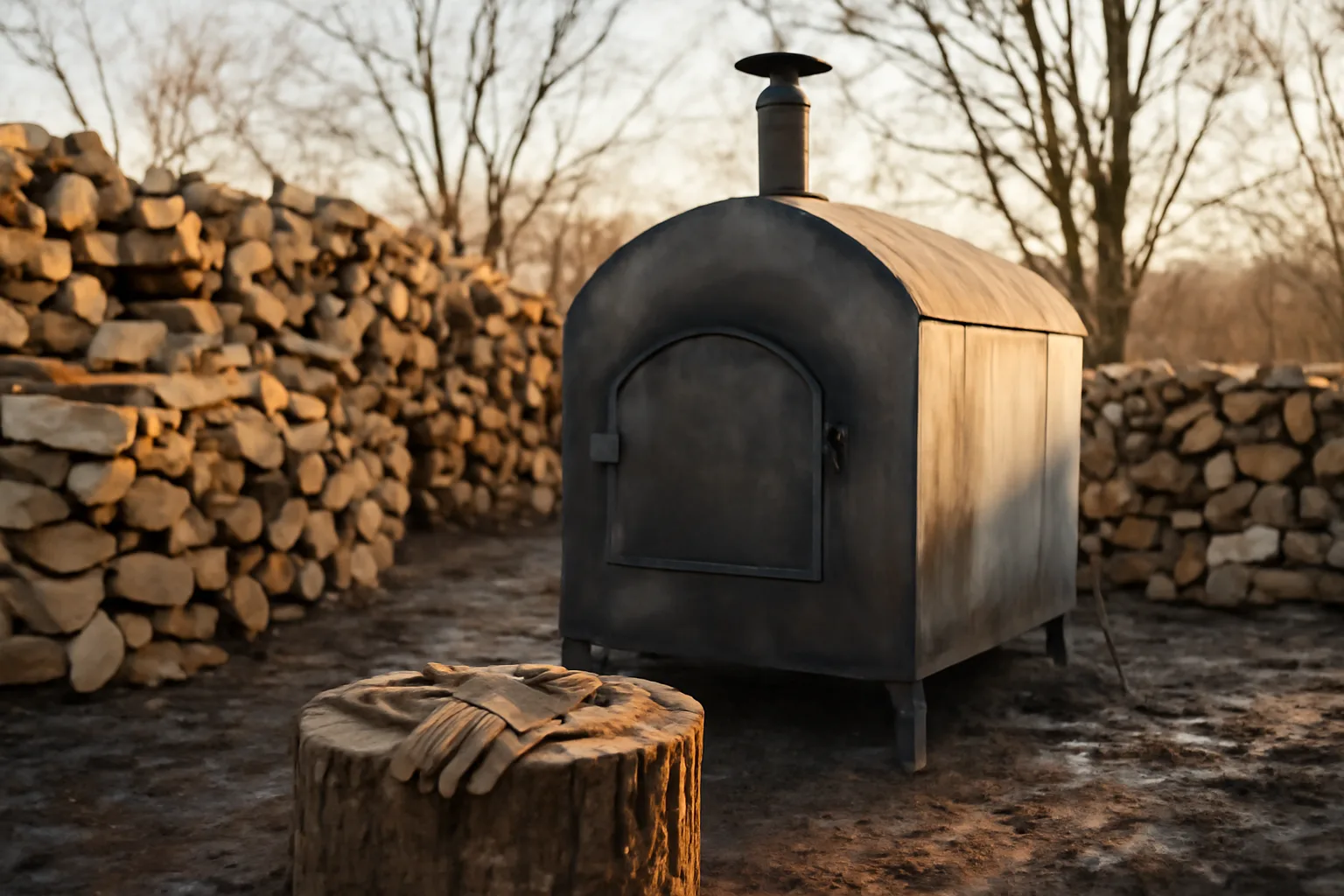
TL;DR
Kiln firewood is split fuel wood dried in a kiln, usually toward under 20% moisture. If the core also hits a published time and temperature, some states treat that load as heat treated for pest rules. Starting is a legal site, a 128 cubic foot cord measure, labels a board will accept, and heat records. Confirm forms locally. There is no national kiln firewood license.
What is kiln firewood?
Kiln firewood is split fuel wood that spent time in a heated chamber so water leaves the pieces faster than it would in an open air stack. That is the whole product. You are still selling firewood, not lumber and not a federal grade.
People mash two jobs into one phrase. Drying means moisture drops, often toward 20 percent or less, which is the household burn target EPA Burn Wise keeps pointing at for cleaner fires [1]. Heat treatment means the core of the wood held a published temperature for a published time so insects and pathogens die. You can dry a load and still have no treatment record. You can hit a pest kill and still hand someone wet wood. Buyers mix those up every winter.
Green wood holds a lot of water. Thick rounds dry slower than splits. The USDA Forest Products Laboratory Wood Handbook is the reference for how moisture sits in wood and why heat and airflow change the rate [2]. Split first. Then run the kiln.
I treat kiln firewood as a claim you back with a moisture number. If you also print heat treated on the wrap, you need a temperature log for that lot. No log, no treatment claim.
A decent cycle leaves wood lighter, with some end checking, and a meter that does not read like a sponge. If the piece still hisses on a stove, the cycle was too short or the stack was packed like a brick. Species still sets the heat. A kiln does not turn boxelder into hickory. Say the species on the tag.
How do you start kiln firewood?
You start kiln firewood by locking a legal site, then proving you can measure a cord, then proving your heat does what the label says. Equipment is later. That order is how you keep from buying a chamber you cannot turn on.
Zoning and neighbors come first. A kiln is a heat source with fans, trucks, and a wood pile that looks commercial from the road. Towns care about smoke, noise, and stored fuel. HOA covenants can block stacking even when the county zoning map looks friendly. Read those documents before you pour a slab.
Next, a business identity your state already knows (sole prop or LLC), a sales tax account if you sell to the public, and a conversation with weights and measures about selling by the cord. A cord is 128 cubic feet of stacked wood [7][8]. Truckload is not a legal unit. Face cord is a fight waiting for Saturday.
Then plant health. If wood will leave your county or cross a state line, read your DNR or agriculture firewood page. Minnesota and Wisconsin both police firewood on public land and care about heat-treated or certified sources [5][6]. New York limits untreated firewood to 50 miles from its source [10]. Those are local paper paths, not a national myth.
Last, the kiln, core probes, a written log, a moisture meter you actually use, and insurance. I'd sell a winter of honestly air-dried wood while you commission the chamber. Starting a new heat process and a new route book in the same October is how people bounce checks.
If you are still weighing this against a paycheck job, the comparison is not romantic. Read kiln firewood vs nearby career before you sign a kiln quote.
Is kiln-dried firewood the same as heat-treated firewood?
No. Kiln-dried means you pulled water. Heat-treated means you held a published kill schedule. Same box can do both. Many loads do only one.
Inspectors and park rangers do not care that your marketing says kiln. They care whether the lot is on a list, carries a treatment mark, or stays inside a mileage cap. USDA APHIS treats firewood as a pest pathway and points people at heat treatment and local wood [11]. Don't Move Firewood makes the same pest-pathway case in plain language [12].
Here is the practical split I use on tags.
| Claim on the wrap | What it actually means | Paper that backs it |
|---|---|---|
| Kiln dried | Moisture was lowered with heat | Moisture readings by lot |
| Heat treated | Core hit a published time and temperature | Probe log and lot number |
| Seasoned | Air dried, often many months | No federal form, meter still smart |
| Certified for a state land program | Met that state's firewood list | Current agency list or certificate |
If a seller cannot tell you which row they are in, they are in none of them. Pay for wood, not adjectives.
Federal phytosanitary treatment rules live in 7 CFR Part 305 [4]. That part is about approved treatments, not a consumer firewood license. Do not tell customers you are USDA certified unless a real compliance agreement says so. Confirm with the relevant plant board.
What moisture content should kiln firewood hit?
Aim under 20 percent moisture for wood you want people to burn in a stove or insert. That is the number EPA Burn Wise guidance is built around for dry fuel [1]. It is not a kiln license. It is the burn target.
Penn State Extension and other land-grant pages walk through seasoning, storage, and why wet wood wastes heat [7]. Colorado State University Extension's firewood fact sheet covers the same household reality: dry wood, stacked off the ground, covered on top [8]. University of Minnesota Extension adds the pest angle on buying and storing [9]. None of those pages replace a meter on your own piles.
Green moisture varies by species and season. The Wood Handbook is honest about that spread, which is why a single kiln recipe copied from a forum fails [2]. Thick oak from a spring harvest is not the same load as summer-split ash.
I meter several pieces per pallet, not one trophy stick from the edge. Ends read drier than cores. If you only probe the outside, you will ship wet centers and get angry reviews you earned.
Nobody has a clean national study of average firewood kiln final moisture by species. Shop talk is not data. Use the meter. Write the number on the lot sheet.
What heat and time numbers do inspectors use?
There is no single U.S. kiln firewood temperature law that covers every driveway sale. There are published treatment schedules, state firewood programs, and a wood-packaging standard people borrow by accident.
ISPM 15 (the international wood packaging standard) says wood should be heated to "a minimum temperature of 56 °C for a minimum duration of 30 continuous minutes throughout the entire profile of the wood" [3]. That sentence is about pallets and crates. Firewood sellers quote it anyway. If you use it, say you met ISPM 15 time and temperature. Do not say the pallet standard is a firewood license.
Many state firewood programs use a hotter, longer firewood schedule, often talked about as 60 C (140 F) for 60 minutes in the core. Treat that as a board-confirmable fact, not something I can stamp as one federal number. Ask your state plant board or DNR what schedule they recognize for labeled heat-treated firewood [5][6][10][11].
USDA phytosanitary treatments are cataloged in 7 CFR Part 305 [4]. If you want to move wood in a quarantine or export setting, that is the federal door. A backyard kiln selling to the next town over usually never enters it. Pretending otherwise is how labels get stupid.
Probes belong in the slowest-heating core, not on the plenum wall. Wall air is a vanity number. Core wood is the treatment.
How do you measure a cord of kiln firewood?
You sell kiln firewood by the cord or a stated fraction of a cord. A cord is 128 cubic feet of stacked wood. Penn State Extension states that as a stack 4 feet high, 4 feet wide, and 8 feet long [7]. Colorado State University Extension uses the same stacked-cord picture [8]. That volume is the method-of-sale fact weights inspectors actually know.
Loose thrown wood in a dump truck is not a cord until it is stacked and calculated. If you sell thrown, say thrown cubic feet and the equivalent stacked estimate, and expect an argument. I'd rather stack and photograph.
A face cord is usually a 4 by 8 face with the piece length you cut, often 16 inches. It is not 128 cubic feet. If your state lets you sell it, the length of the pieces has to be on the invoice. Confirm with the relevant weights and measures office. I will not invent their current pamphlet number.
Kiln-dried wood is lighter per cord than green wood of the same species. Customers sometimes think you shorted them because they can lift the pieces. Show the stack dimensions, not a scale ticket, unless you are in a rare place that allows sale by weight. Most firewood method-of-sale rules are volume.
Put the cubic measure on every invoice. Superlatives do not survive a complaint.
What licenses and paper do you need in year one?
There is no national kiln firewood license. Year-one paper is a pile of ordinary local filings plus any firewood program you choose to join.
Expect some mix of a local business license, a sales tax permit, a weighmaster or method-of-sale chat, and land-use approval for the kiln and the pile. If you cut on land you do not own, you need that owner's paper too. National forest personal-use firewood permits are a different animal and do not magically authorize a commercial kiln yard [13].
If you want wood to travel, add plant-health paper. New York's untreated 50-mile cap is the clean example of a state rule with a number you can actually print [10]. Minnesota's DNR firewood page is the clean example of public-land rules that prefer heat-treated or approved wood [5]. Wisconsin publishes its own firewood limits and certified-source path [6]. Copy the state you operate in. Do not copy a podcast.
FirewoodPath sells a $129 one-time Moisture + Cord + HOA Kit at /start if you want those three checklists in one folder. You do not need it to use this article. A meter, a cord diagram, and your HOA packet already cover the same ground.
Variable fees, quotas, and processing times change. Confirm with the relevant board. I will not invent a current dollar figure or a promise that a form comes back in two weeks.
Keep lot sheets: date in, species, start moisture, end moisture, core temperature chart, date out, who bought it. That notebook is the business.
Can you haul kiln firewood across a state line?
Sometimes. Kiln-dried is not an automatic passport. Heat-treated with a record the receiving state recognizes is closer. Local wood is still the easy answer.
USDA APHIS keeps saying firewood moves pests [11]. University of Minnesota Extension repeats the same buying advice: get wood near where you burn it [9]. Don't Move Firewood exists because campers and sellers keep losing that argument [12].
State lines are worse than county lines. Receiving states write their own firewood import rules. Some want labeled heat-treated wood. Some want you to stay inside a mileage bubble. Some only care when you enter state land, then they care a lot [5][6][10]. Confirm with both the origin plant board and the destination board before you book a trailer.
Federal treatment rules in 7 CFR Part 305 matter if you are in a real phytosanitary program [4]. Most first-year yards are not. If a broker tells you a kitchen kiln is an APHIS export stamp, walk away.
I'd build year one on a 50-mile customer circle even if your kiln is excellent. Distance is where labels and inspections get expensive. Heat does not erase paperwork.
What equipment do you need versus what is a waste of money?
You need a way to split, a way to move, a chamber with controllable heat and airflow, core temperature probes, a moisture meter, and racks that let air through. That is the kit. Everything else is optional until orders force it.
A brand-new firewood processor in year one is usually a waste of money. It makes you very fast at producing wood you have not sold. A saw you can keep sharp and a splitter you can fix at night will teach you demand. Upgrade when the bottleneck is labor, not customers.
Kilns range from a converted container with a hot-water coil to a small lumber kiln. I will not pretend there is one honest national price. Get three quotes. Ask what happens when a probe fails at 2 a.m. Cheap controllers without a data log are how treatment claims die.
Bagging lines are a packaging business glued onto a wood business. Skip bags until a store account is real. Shrink wrap on a pallet is enough for most driveway routes.
Buy a decent meter before you buy more steel. EPA's 20 percent burn target is only useful if you measure [1]. For a side-by-side of other kiln firewood writeups, kiln firewood guide 12 is a reasonable next click.
How long does kiln drying take versus air seasoning?
Air seasoning, done right, is often six months or more. EPA Burn Wise still tells households to split, stack, cover, and store wood through a dry-out period measured in months, not weekends [1]. Extension pages say the same in slower language [7][8].
A firewood kiln can drop moisture in days, not seasons, if the wood is already split, the load is stickered, and the starting moisture is not absurd. How many days? Nobody has a good public national dataset by species and kiln type. Operators talk about one- to three-day cycles a lot. That is shop talk. Your oak will laugh at a cycle that worked on ash.
The Wood Handbook is still the physics book: thickness, species, starting moisture, temperature, and airflow set the clock [2]. Copying a YouTube schedule is how you scorch ends and leave wet cores.
Heat treatment time is shorter than full drying time if you only need a pest kill. That is why a load can be heat treated and still be a miserable burn. Run the extra hours if you sold dryness.
I'd rather run fewer, fully dry charges than chase throughput. Wet kiln firewood is a reputation hole you do not climb out of in one town. More comparison notes sit in kiln firewood guide 18.
What first-year operating mistakes waste money?
Overbuilding the kiln before you have a route. That is the expensive one. A pretty chamber with no Saturday deliveries is a hobby with a propane bill.
Underbuilding records is the quiet one. You will forget which pallet hit 20 percent. Customers will not. Rangers will not. A paper log in a clipboard beats a memory.
Selling by the pickup load is the complaint magnet. Use 128 cubic feet or a stated fraction [7][8]. Photograph the stack against a tape.
Ignoring plant-health mileage is how a good kiln still gets you in trouble at a campground gate [5][6][10][12]. Heat does not help if the receiving rule wanted local wood or a certificate you never applied for.
Hiring a crew before you know your cords per week. Firewood is peaky. October is not March. Pay overtime in peak week before you add a person you cannot keep busy in May.
I'd also skip fancy species blends until you can explain them. Mixed hardwood is fine if the moisture is honest.
If you like checklists of adjacent topics, kiln firewood guide 24 and kiln firewood guide 30 are next-door reading, not required steps.
What should a kiln firewood label and moisture ticket show?
A useful label names the seller, contact, species or mixed hardwood, the quantity in cords or a fraction, piece length, and the date of the lot. If you claim kiln dried, put a moisture range and the meter method. If you claim heat treated, put the schedule you met and a lot number that ties to a probe chart.
Do not print USDA certified, ISPM 15 certified, or state certified unless the named program actually listed you. ISPM 15's 56 C for 30 minutes quote is real for packaging wood [3]. It is not a sticker you get to improvise.
Moisture tickets can be ugly. Handwritten is fine. Sample several pieces. Note whether you read a split face or a fresh cut. Customers who own stoves know wet wood when they burn it. EPA's dry-wood advice is sitting on the same internet they use [1].
HOA and town pile rules belong on your site map, not on the consumer wrap. Still, if a covenant caps stacking height, your inventory plan has to match or you will fight the wrong battle in January.
I would add a one-line origin county. That single line solves a lot of Don't Move Firewood conversations before they start [12]. For more label-adjacent comparison pieces, see kiln firewood guide 36.
Where do HOA, town, and insurance rules bite on a kiln yard?
They bite on smoke, stored fuel, truck noise, and fire setbacks. The kiln is obvious. The pile is what neighbors photograph.
HOAs often ban commercial activity or outdoor storage that looks like a woodyard. If you live in one, get the covenant language in writing before you take deposits. Town zoning may still want a home-occupation cap on employees, hours, and signage. Confirm with the planning desk. No national chart covers that.
Insurers care about kilns as heat appliances and about wood as fuel storage. Tell them it is a kiln, not a shed. Omissions here are how claims get weird. I am not your broker.
National forest personal-use rules do not cover a commercial kiln, and they still want you to burn local wood when you camp [13]. Keep those worlds separate.
FirewoodPath is an independent publisher, not a law firm and not a service company. Nothing here is an approval, a timeline, or a substitute for the board that actually stamps paper.
If you want another pass at neighboring how-to comparisons, kiln firewood guide 42 is a fair last click. Then go measure a pile.
Frequently asked questions
What is kiln firewood?
Kiln firewood is split fuel wood dried in a heated chamber so moisture drops faster than in an open stack. It is still firewood, not a federal grade. If the core also held a published time and temperature, some buyers and states treat that lot as heat treated. Ask for a moisture number and, for treatment claims, a probe log.
How do you start kiln firewood?
Lock a legal site first, including zoning and any HOA rules. Then set up ordinary business and sales tax paper, learn the 128 cubic foot cord, and read your state's firewood movement page. Add a kiln with core probes, a moisture meter, and insurance. Confirm fees and forms with the local boards. There is no national kiln firewood license.
Do you need a USDA license to sell kiln firewood?
Usually no. Driveway and local sales run on town, tax, and weights rules. USDA APHIS and 7 CFR Part 305 matter if you enter a real phytosanitary or compliance-agreement program. Do not print USDA certified on a wrap because you own a hot box. Confirm with the plant board that has jurisdiction over your loads.
How hot does a firewood kiln need to get?
Drying heat is whatever drops moisture without scorching the load. Pest-kill heat is a published schedule. ISPM 15 uses 56 C for 30 continuous minutes throughout the wood profile for packaging. Many state firewood programs talk about a 60 C core for 60 minutes. Confirm the schedule your board will recognize.
Can kiln firewood still have bugs?
Yes, if you only dried it and never held a kill temperature in the core, or if you mixed treated pieces with untreated ones after the kiln. Heat treatment is lot-based. A clean wrap on a dirty pallet is not a treatment. Park rules in places like Minnesota still want approved or heat-treated wood on many state lands.
Is kiln-dried firewood worth more than seasoned wood?
It can be, if it is actually drier and ready mid-season when air-dried piles are still wet. The premium dies if your meter reads like seasoned wood you rushed. EPA's burn advice is still 20 percent moisture. Charge for dryness and records, not for the word kiln.
How do you prove heat treatment to a ranger?
With a lot number that ties to a temperature chart, plus whatever certificate or vendor list that state land system publishes. Minnesota and Wisconsin both describe approved or heat-treated paths on their firewood pages. A verbal kiln story is not proof. If you cannot show paper, sell inside the local-wood rule and skip the argument.
What moisture meter should you use on kiln firewood?
Use a meter you will actually carry, then cut a fresh face so you are not reading a kiln-baked shell. Pin meters are honest on split wood if you know species corrections. Pinless meters are faster and easier to fool on rough bark. Nobody has a perfect public bake-off. Compare the meter to oven-dry samples if you get serious.
Can you kiln dry softwood and sell it as firewood?
Yes, if buyers want it and your label says the species. Softwood lights easily and burns faster. It is a poor substitute for dense hardwood in a long stove overnight. Resin and sparks matter in open fireplaces. Say pine if it is pine. Mixed hardwood that is secretly pine is how you lose repeat stops.
Do you need a firewood processor to start?
No. A processor is speed. Year one usually fails on sales, paper, and wet wood, not on pieces per hour. A saw and splitter you can repair will teach you the market. Buy the processor when labor is the bottleneck and the route book is already ugly in a good way.
Is a face cord a legal way to sell kiln firewood?
Only if your weights office allows it and you state the piece length and the stacked measure clearly. A cord is 128 cubic feet. A face cord is a 4 by 8 face with whatever length you cut, so the cubic feet change. Confirm with the relevant weights and measures office before you print flyers.
Can you run a firewood kiln on residential property?
Sometimes, if zoning, HOA covenants, setbacks, and insurance all say yes. Many residential rules cap commercial traffic, outdoor storage, and smoke. A kiln looks and sounds industrial at 5 a.m. Get the covenant and the zoning note in writing. I will not guess your town's current permit fee.
What belongs on a kiln firewood invoice?
Seller name, date, species or mixed hardwood, quantity in cords or a stated fraction, piece length, lot number, and any kiln-dried or heat-treated claim with the moisture or schedule behind it. Origin county helps with pest rules. Keep a copy with the probe chart. Pretty logos do not survive a cord complaint.
Sources
- U.S. EPA Burn Wise, Best Wood Burning Practices: EPA Burn Wise household guidance to burn dry, seasoned firewood and to split, stack, cover, and store wood for clean combustion.
- USDA Forest Products Laboratory, Wood Handbook FPL-GTR-190: Reference data on wood moisture, drying behavior, and fuelwood-related properties used to explain why species and thickness change kiln results.
- IPPC, ISPM 15 (2016) Regulation of wood packaging material: Heat treatment of wood to a minimum of 56 C for 30 continuous minutes throughout the entire profile of the wood.
- eCFR, 7 CFR Part 305 Phytosanitary Treatments: Federal catalog of USDA-approved phytosanitary treatments, including heat, for regulated plant products.
- Minnesota DNR, Firewood: Minnesota DNR restricts firewood on many state lands and describes approved, heat-treated, or certified firewood paths.
- Wisconsin DNR, Forest Health: Wisconsin firewood movement limits and certified or approved source rules for public land and pest protection.
- Colorado State University Extension, Firewood 6.115: Land-grant firewood guidance including the stacked cord measure and dry storage practice.
- New York DEC, Firewood and invasive pests: New York untreated firewood may not be moved more than 50 miles from its source; treated and labeled wood is the import path.
- Don't Move Firewood: Firewood can move invasive insects and diseases; keep firewood local.
- USDA Forest Service, Visit main page: National forest firewood use is governed by local forest rules and personal-use permits, separate from a commercial kiln yard.