Last updated 2026-08-21
TL;DR
Kiln firewood is split wood dried in a kiln, usually to 20% moisture or less. If you ship it, USDA heat treatment is 60°C (140°F) for 60 minutes. There is no national kiln firewood license. Start with zoning, cord measure (128 cubic feet), and the state plant board if you cross lines. Confirm fees with the board that charges them.
What is kiln firewood?
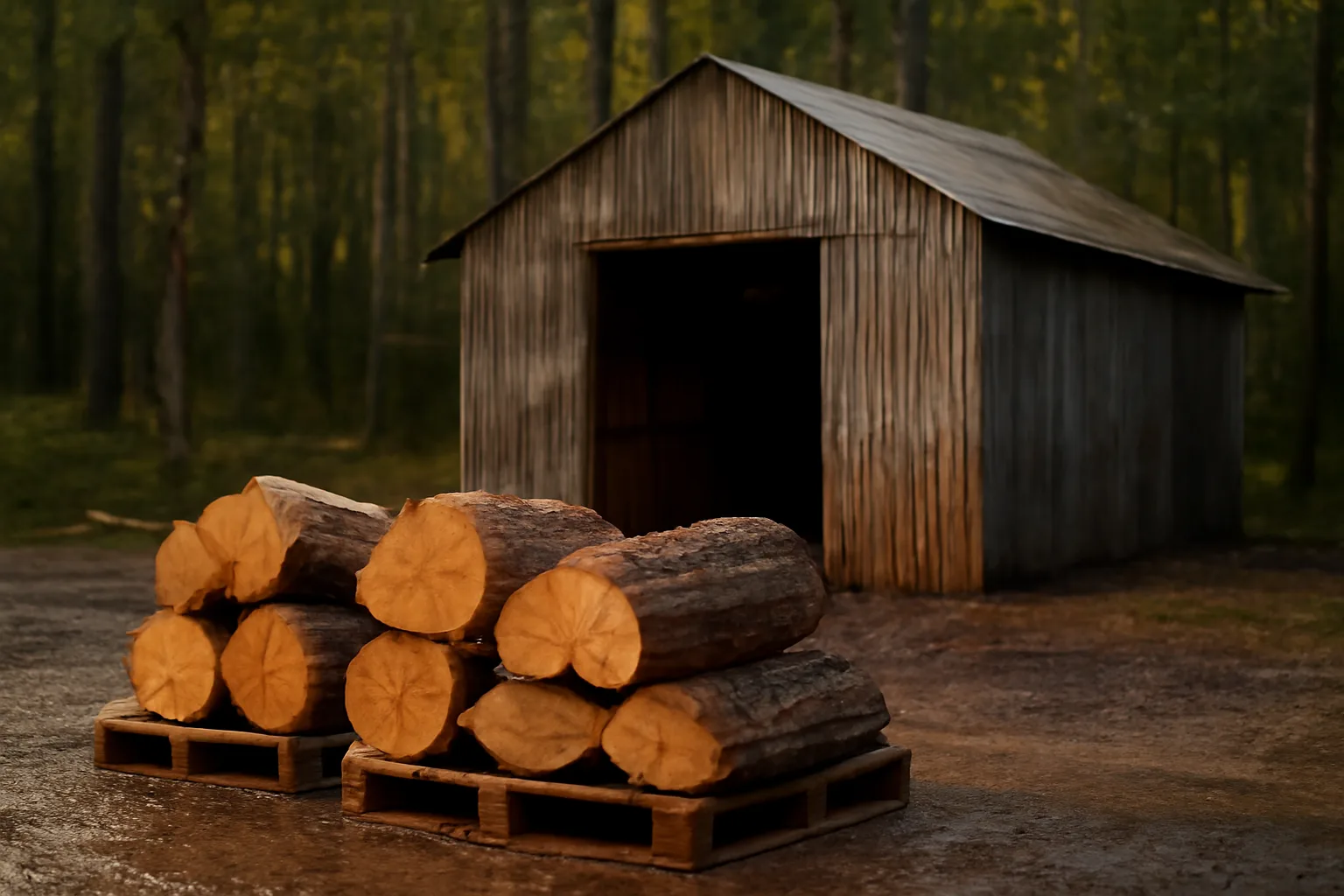
Kiln firewood is split firewood dried in a kiln rather than only in open air. Most sellers aim for about 20% moisture or less, the seasoned line EPA uses for cleaner burning [1]. If the wood will travel or go to a park, many operators also run a USDA-style heat hold of 60°C (140°F) for 60 minutes [6].
It is a process claim, not a federal grade. You do not buy a kiln firewood stamp from Washington.
Three jobs get mashed into one word. Seasoning is time and wind. Kiln drying is a box with heat or dehumidifiers. Heat treatment is a pest schedule with a core sensor. You can kiln-dry and still fail a moisture check. You can hit 20% and still lack a chart a ranger will accept. Write the invoice for the job you did.
Green wood holds a lot of water. The USDA Forest Products Laboratory notes that green moisture content varies widely between species and can sit over 50%, and in some species exceed 100% of oven-dry weight [4]. A kiln pulls that down in days or a couple of weeks, not a long covered stack.
I would not call a warm shipping container kiln firewood in your ads unless you log temperature and moisture. Buyers have heard that story. If you cannot split a piece and meter the fresh face, you are not ready to use the word kiln.
How dry does kiln firewood need to be?
Kiln firewood for stove sales should read at or under 20% moisture in a fresh split [1]. That is the EPA Burn Wise seasoned line. Pest-kill is a different check: a 60-minute hold at 60°C (140°F) in the core if you need USDA-style treatment [6]. Local sales can skip the pest chart. They should not skip the meter.
EPA's Burn Wise guidance ties clean burning to dry wood and treats 20% moisture as the seasoned line for firewood [1]. Wetter wood wastes heat because the fire spends energy boiling off water inside the stick before it can warm your house. EPA treats 20 percent moisture as the seasoned firewood line (EPA Burn Wise).
I aim a little under 20% so a humid shed does not push the stack back over the line. 15% to 18% on oak is a comfortable band. Nobody has good national data that 15% outsells 19%. The published consumer rule is still 20% [1].
Meter the center of a piece you just split. Sun-baked bark lies. If two pieces from the same cart disagree by a wide margin, the load is uneven. Stickers and baffles fix that. A bigger burner does not.
The University of Minnesota Extension still tells buyers to store dry wood off the ground and covered, which applies after a kiln too [9]. Selling "kiln dried" at 28% because the shed felt warm is a waste of the word. You will hear about it when the stove door weeps.
How do you start kiln firewood?
You start kiln firewood by drying a repeatable load, then adding local paper. There is no national kiln firewood license [11]. Register the business with your state, ask county zoning about a kiln and outdoor storage, and talk to weights and measures before you sell by the cord [5]. Confirm every fee with the board that bills it.
Here is the order I would actually use. Get a pin moisture meter and a written cord definition on your invoice. Call zoning and log the call. If neighbors or an HOA can shut you down, read that before you pour a slab. Nuisance and access fights are their own mess, so read a focused note on neighbor and HOA risk before you commit.
If you sell by volume, a cord is 128 cubic feet when the wood is ranked and well stowed [5]. NIST Handbook 130 defines a cord as 128 cubic feet of ranked, well stowed wood. Face cords are a fight waiting to happen. Define the pile in cubic feet.
If you will leave the state or sell to public campgrounds, call the destination plant board. Minnesota requires certified firewood on many DNR sites [8]. Wisconsin runs a certified firewood program [10]. Maine restricts untreated imports [13]. The federal emerald ash borer quarantine is gone, so the state is the rulebook [7].
I would not sign a lease on a 20-cord wood-fired kiln in month one. Run a small dehumidifier chamber or a tight solar kiln until you know your species mix. SBA is clear that licenses live at city, county, and state counters [11]. No one can promise you a timeline.
Do you need a license to sell kiln firewood?
You do not need a federal license to sell kiln firewood from a local yard. You may need a state business registration, a local zoning okay, a sales tax permit, and a weights and measures review if you sell by the cord [11] [5]. Parks and some states add a heat-treatment certificate. Confirm with the relevant board. No approval is guaranteed here.
People waste money on nationwide firewood permits sold on social media. That product does not exist. After APHIS removed the domestic emerald ash borer quarantine, federal firewood rules got thinner, not thicker. The Federal Register action said, "We are removing the domestic quarantine regulations for the emerald ash borer (EAB)" [7]. States filled the gap.
If you only sell inside your county, your hard paper is usually zoning, tax, and honest volume. If you sell to a state park in Minnesota, certified heat-treated wood is the gate [8]. Those are different businesses.
Keep the certificate, if you have one, with the batch, not in a junk drawer. Inspectors ask for the run that matches the load on the truck.
For injury and delivery claims, read delivery and pile liability before you hire a helper with a splitter.
What heat treatment does USDA require for firewood?
USDA-style firewood heat treatment is a core temperature of 60°C (140°F) held for 60 minutes [6]. USDA APHIS firewood heat treatment holds the core at 60°C (140°F) for 60 minutes. That schedule is the one state certifiers still copy. Do not treat a wall thermostat as a core reading.
The number lives in the APHIS Plant Protection and Quarantine Treatment Manual, the T314 firewood schedules [6]. You need sensors in the wood, more than air temp in the box. Wall air can read hot while the center of a dense oak round is still cool.
I would not ship across a state line on a we-ran-it-hot story. Maine can stop untreated imported firewood [13]. Wisconsin certification wants a documented process [10]. Your kiln brand does not impress a plant inspector. The chart does.
Local stove wood does not automatically need this hold. Dryness is still required if you used the word kiln. Heat-treat plus wet core is a real failure mode when someone cranks the burner and shortens the cycle.
If a buyer asks for certified kiln firewood, ask which certificate. Park, state, or just a moisture slip. Those are different pieces of paper.
Can you take kiln firewood across state lines?
You can move kiln firewood across many state lines if the destination state accepts heat-treated or certified wood, and if you actually ran the hold [7] [10] [13]. The old federal EAB quarantine is gone [7]. State plant boards and park systems now make the call. Confirm before you load. Do not take a blog's map as a permit.
Minnesota DNR sites want certified firewood, not a random pickup-truck pile [8]. Wisconsin runs a certified firewood program [10]. Maine treats imported untreated firewood as a pest risk [13]. Your home state being relaxed does not bind the state you drive into.
Keep origin, species if you know it, treatment date, and destination on a simple load sheet. If a ranger asks, you want one page, not a story.
I would not build a year-one business on interstate campground routes. The paper is doable. The empty backhaul and the seasonal scramble are what hurt. Sell local first. Add one destination state when you have a repeat buyer and a treatment log they already accepted.
Some states still limit how far untreated wood can move. Kiln treatment is how you get out of that box. Read the destination page, not a Facebook group. Rules change. Confirm.
How is a cord of kiln firewood measured?
A cord of kiln firewood is 128 cubic feet of wood, bark, and air space when the pile is ranked and well stowed [5]. That is the NIST Handbook 130 method of sale used by most state weights and measures programs. If you sell by the cord and short the pile, you have a measuring problem, not a marketing problem.
Put the 128-cubic-foot figure on the invoice in buyer language. A face cord is usually a single rank of 16-inch pieces, and the volume depends on the length of the pile. I would print cubic feet. Face cord arguments eat evenings.
Loose thrown piles in a dump truck are not a cord unless you did the math on the box. Kiln-dried wood is often stacked on pallets. Count pallets times known volume, then stop using truckload as a unit.
If your state adopted Handbook 130, the inspector already knows the 128 number [5]. You will not talk your way around it. For claims after a delivery short, see short-cord complaints.
What equipment do you need in year one?
Year one, you need a kiln you can instrument, a pin moisture meter, pallets or rails, a splitter, and a covered dry shed. You do not need a firewood processor, a custom boiler, or a new dump truck. Those are how people go broke before the first heating season.
A small dehumidifier kiln inside an existing shed is the path I like if you already have power. Solar kilns work if you are patient and you still meter the core. Wood-fired chambers dry fast and can drag you into air-permit questions. Ask the state air board before you buy a used boiler. Confirm. Do not trust the seller's claim that nobody ever asked.
Skip moisture-meter-free operation. A cheap pin meter (street prices move, so shop current listings) pays for itself on the first rejected load. I would not buy a pinless-only meter for rough splits. Pins in a fresh split are the honest read [3].
The Forest Products Laboratory drying chapters are the adult reading list if you want kiln schedules and why oak is slower than ash [3] [14]. You do not need a consultant to interpret leave space for air.
Insurance and a written delivery rule matter as much as the chamber. Read splitter and yard injury before you let friends help for wood.
What paperwork should you keep for each kiln run?
Keep a run sheet per kiln load: species mix if known, start date, sensor placement, peak core temperature, hold time, end moisture on at least three pieces, and where the load went. If you heat-treat, clip the chart to that sheet [6]. If you only dry, still write the moisture. Memory is not a record.
Weights and measures may want your method of sale on ads and invoices [5]. Parks want the certificate number [8]. Your insurer will want something if a pallet dumps on a driveway. That last pile of paper is why customer property claims is worth a read before peak season.
FirewoodPath publishes a $129 one-time Moisture + Cord + HOA Kit if you want those templates in one folder. You can also make a two-column spreadsheet and a zoning letter yourself. The kit is optional. The records are not.
Do not promise a moisture number you did not measure on that batch. Date the reading. Wood picks up water in a rain week.
I keep photos of the stacked cord against a tape or a known pallet size. It is crude. It ends arguments.
What does a first-year kiln firewood setup cost?
Nobody publishes a clean national cost curve for standing up kiln firewood. Used chambers, homemade solar boxes, and turnkey dehumidification units do not live on one price list. Expect a spread from a few thousand dollars for a small DIY or used setup to much more for a commercial chamber with controls. Get current quotes. Ignore old forum numbers.
Operating cost is power or firewood, labor to stack and sticker, and wrapping. Electric kilns make a utility bill you can see. Wood-fired kilns burn your own inventory. I have not seen a peer-reviewed national average for cost per cord of kiln firewood. Anyone who quotes one without a study is guessing.
Do not finance a building until you have sold wood from a smaller box. Zoning can still say no [11]. That is a bad loan.
Variable fees (sales tax permit, weights and measures, certification) are set by your boards. Confirm them there. This page will not invent a dollar figure for your county.
If cash is tight, air-dry under cover and kiln only the last stretch of moisture. That hybrid is common. It is also how you miss pest holds if you never ran the 140°F hour [6]. Pick the product.
Is kiln firewood worth it compared with seasoned wood?
Kiln firewood is worth it if you need winter cash flow, park contracts, or a dry product in a wet climate. It is a waste of money if you already have a year of covered oak and your buyers only want cheap fill. Seasoned wood still burns clean when it is actually at 20% [1].
The kiln buys speed and a story you can document. It does not raise heat above equally dry air-dried wood of the same species. Dry is dry. The Forest Products Laboratory drying work is about moisture movement, not a special kiln molecule [3] [14]. Colorado State Extension's firewood fact sheet is a solid species and burning primer if you are new to the stove side of the sale [12].
I would kiln if I were selling in August for October delivery, or if a campground required certification [8]. I would not kiln if my only edge was a logo on a mesh bag.
Price premium varies by town. Nobody has good public scanner data on kiln vs seasoned retail across the U.S. Walk two competitors with a meter. That is the study.
For disputes over not as advertised, see ads and moisture claims.
What first-year mistakes waste money?
The expensive first-year mistakes are buying too much kiln, selling by the truckload, skipping zoning, and treating heat and dryness as the same thing. A processor you use four weekends a year is the other classic hole.
Do not hire a consultant to obtain a federal firewood license. There isn't one [11]. Do not take untreated wood into a state park that publishes a certified list [8]. Do not ignore an HOA that bans home businesses. For the covenant fight, HOA and home-based kiln limits and nuisance complaints are the next reads.
Meter every load. Write 128 cubic feet on the invoice [5]. Run 140°F for 60 minutes only if you need that paper, and then actually record it [6].
FirewoodPath is an independent publisher, not a law firm and not a service company. If you want the paper pack, start at /start. Confirm statutes and fees with the board that enforces them. Nothing here is an approval.
Stop when the meter and the tape agree. Everything else is decoration.
Frequently asked questions
What is kiln firewood?
Kiln firewood is split firewood dried in a kiln. Most stove wood is sold at or under 20% moisture, the EPA seasoned line. Some loads also get a 60°C (140°F) core hold for 60 minutes for pests. It is a process you document, not a federal grade. Ask for a meter reading on a fresh split.
How do you start kiln firewood?
Dry a repeatable load, then add local paper. There is no national license. Register the business, check zoning, and talk to weights and measures if you sell by the cord (128 cubic feet). Call the plant board if you cross state lines or sell to parks. Confirm fees with those boards. Start small on the kiln.
Is kiln-dried firewood the same as heat-treated firewood?
No. Kiln-dried means you lowered moisture in a chamber. Heat-treated means the core hit a timed temperature, commonly 60°C for 60 minutes. You can have dry wood without a pest chart, and you can run a hot, short cycle that still reads wet. If a park wants certified wood, they want the heat paperwork.
Do I need USDA certification to sell kiln firewood locally?
Usually no. Local stove sales typically need honest moisture, legal volume, and local business paper. USDA-style treatment matters when a state, park, or buyer requires certified heat-treated firewood. Minnesota DNR sites are a common example. Confirm with the destination, not with a national myth.
What moisture content should kiln firewood be?
For ordinary sales, at or under 20% on a fresh split, matching EPA's seasoned line. Many operators shoot for the mid-teens so storage humidity does not push the stack back up. Meter the interior of a split piece. Surface readings on bark are a bad joke.
Can I sell kiln firewood by the truckload?
You can deliver in a truck. You should still sell by a defined volume. A cord is 128 cubic feet ranked and well stowed under NIST Handbook 130. Truckload is how short-cord fights start. Put cubic feet on the invoice. Measure the box if the wood is thrown loose.
How long does a kiln cycle take?
It depends on species, starting moisture, stick size, and whether you only dry or also heat-treat. A small dehumidifier load can be days to a couple of weeks. Dense oak is slower than ash. There is no honest single-hour figure for all kilns. The cycle is done when the meter and, if needed, the core hold both pass.
Do I need an air permit for a firewood kiln?
Many small electric dehumidifier kilns never need one. A wood-fired boiler or large burner can. This is a state air-board question, not a federal firewood license question. Ask before you buy used combustion equipment. Confirm. Do not take the seller's word that nobody ever asked.
Can an HOA stop a backyard kiln?
Yes, if the covenants ban businesses, outdoor storage, or nuisances, or if zoning underneath the HOA does. Read the declaration before you pour a pad. A kiln looks and sounds industrial to a neighbor who bought a quiet lot. Confirm with the association and the county. No outcome is promised here.
What records should I keep for each kiln run?
Date, species mix if known, sensor placement, core temperature and hold time if you heat-treat, end moisture on several pieces, and where the load went. Keep the chart with the batch. Parks and inspectors ask for the run that matches the truck, not your best load from last month.
Is certified firewood required for campgrounds?
On many public sites, yes. Minnesota DNR is explicit about certified firewood. Other states and campgrounds publish their own lists. Private campgrounds set house rules. Call the destination. Heat treatment plus a certificate is the usual key, not the word kiln on a bag.
Should I sell a face cord or a full cord?
Sell a full cord of 128 cubic feet, or sell cubic feet. A face cord is one rank and the volume changes with log length and pile length. It produces complaints. NIST Handbook 130 is built around the 128-cubic-foot cord. Print the math. Let the customer count.
Should I form an LLC before the first kiln firewood sale?
An LLC can help separate personal assets, but it is not a kiln permit and it does not replace insurance. Talk to a local attorney or accountant. This publisher is not a law firm. Many people register something with the state and still skip zoning. Do not skip zoning.
Sources
- U.S. EPA Burn Wise, Best Wood Burning Practices: Seasoned firewood is treated as 20% moisture content or less for cleaner burning
- U.S. EPA Burn Wise program: Burn Wise ties clean, efficient burning to dry, seasoned wood
- USDA Forest Products Laboratory, Wood Handbook FPL-GTR-190 Chapter 13: Kiln drying and moisture control methods for wood
- USDA Forest Products Laboratory, Wood Handbook FPL-GTR-190 Chapter 4: Green moisture content varies widely by species and can exceed 50% or even 100% of oven-dry weight
- NIST Handbook 130-2023, Uniform Laws and Regulations (method of sale): A cord of firewood is 128 cubic feet when ranked and well stowed
- Federal Register, Emerald Ash Borer Domestic Quarantine Regulations (2020-27047): APHIS removed the domestic emerald ash borer quarantine regulations
- Minnesota DNR, Firewood: Certified firewood is required on many Minnesota DNR sites
- U.S. Small Business Administration, Apply for licenses and permits: Business licenses and permits are issued at city, county, and state level, not as one federal license
- Maine Forest Service, Firewood and forest pests: Maine restricts untreated imported firewood as a forest pest risk