Last updated 2026-08-21
TL;DR
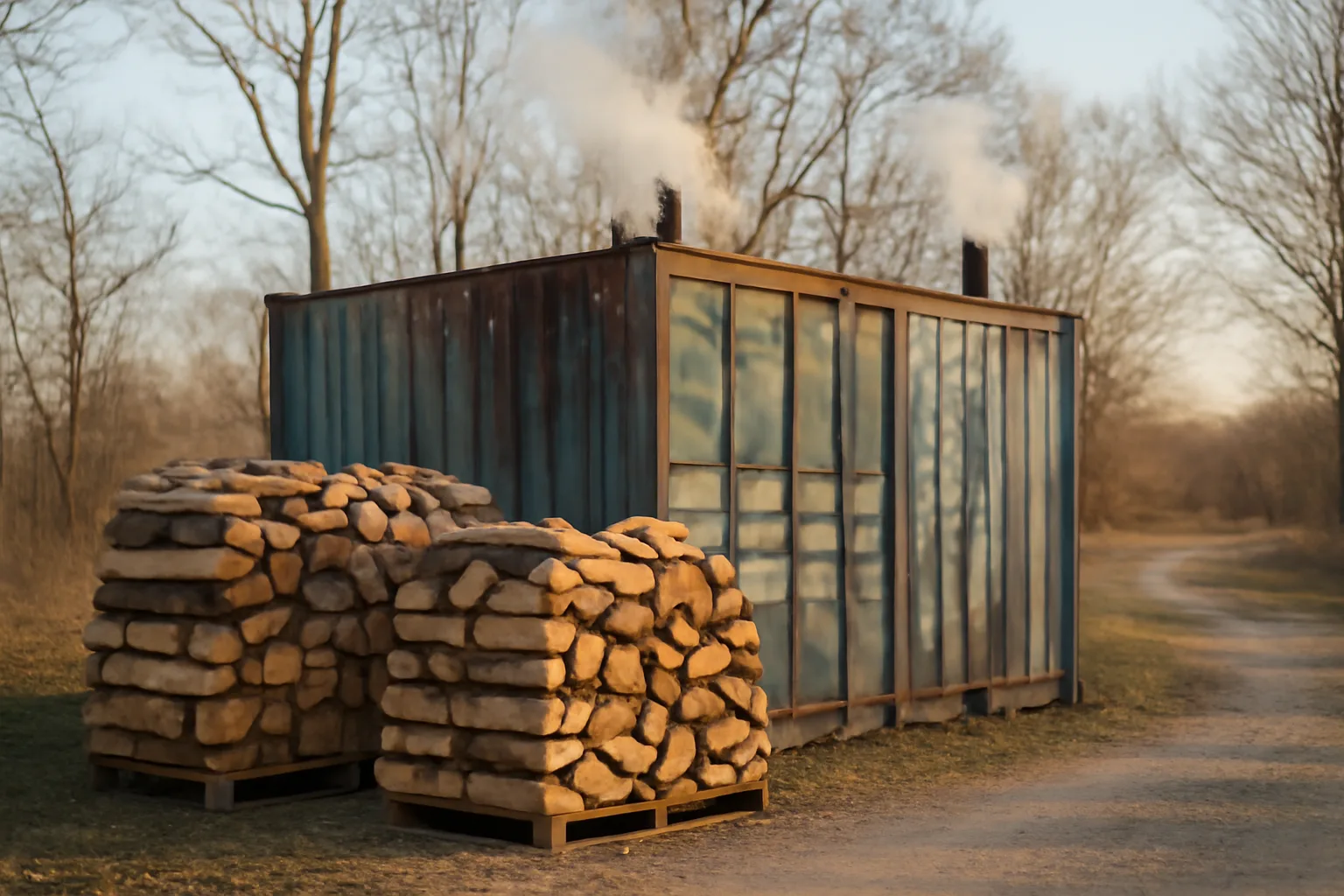
Kiln firewood is split wood dried in a kiln, usually to 20% moisture or less, sometimes with a logged heat schedule for pests. Start by checking zoning and any HOA, then a kiln you can document, then cord measure and local business paper. Skip interstate certificates until you will actually cross a state line that still requires them. Confirm every fee with the board that charges it.
What is kiln firewood?
Kiln firewood is split firewood dried in a kiln instead of only sitting in a stack. The usual claim is low moisture, often 20% or less. It is a drying method. It is not a federal license class, and it is not automatically pest-free.
People mix up three different products. Air-dried wood that finally hits 20%. Kiln-dried wood that hit 20% in days instead of months. Heat-treated wood that held a required core temperature for a required time. You can kiln-dry without treating. You can also blow hot air across wet cores and still sell soggy oak. The box does not magically fix a bad load.
EPA Burn Wise treats wet wood as a pollution problem, not a vibe. The agency's best-practice page tells households to season firewood "for at least 6 months" before they burn it, and it puts dry, seasoned wood at 20% moisture or less [1]. Kiln firewood is how a seller tries to land on that same 20% line without waiting through a wet spring.
Extension services say the same thing in slower language. Penn State walks through preparing, seasoning, and storing firewood, and it still starts with moisture, not marketing [9]. Minnesota Extension does the buying and storing version: keep it off the soil, give it air, and do not believe a tarp pressed tight to the pile [10]. The Forest Products Laboratory Wood Handbook is the physics book behind all of that. Wood holds a lot of water. Kilns move that water if you give them heat, airflow, and time [11].
I would not print "sterile" on a bundle. Heat can kill insects if you actually hit the schedule. Drying to 18% does not, by itself, mean a state park will take the truck. Customers hear kiln and think campground-legal. Those are different stickers. Wisconsin DNR still wants certified firewood on many of its properties [12]. That certificate is a treatment and labeling trail, not a Facebook photo of a container.
Kiln firewood is still just wood sold by measure. A pretty wrap around 0.3 of a cord is not a cord. If you cannot stack it and multiply to 128 cubic feet, you do not have a cord [8]. Start there, then worry about stainless vents.
How do you start kiln firewood?
You start by deciding where the kiln sits and who you will sell to, then you collect local paper, then you buy a kiln you can log. You do not start by applying for a national kiln firewood license. That license does not exist.
Walk the site first. If it is a backyard, assume a neighbor will call someone the first night the burner runs. If it is HOA land, read the covenants before a container hits the gravel. If it is unzoned rural, you still have fire code. You may have an air rule if you burn wood to heat the kiln. Confirm that with the local building official and, if you burn, the air board. I will not guess your county.
Pick a market on purpose. Local pickup. Local delivery. Interstate. Interstate is the one that pulls pest paper. Most new sellers should stay in-state for a season. You will learn loading, moisture, and no-shows without a plant inspector in the mix. If you later need the continuing trail in a specific state, the renewal writeups are the honest version of that paper, including kiln firewood renewal in california and kiln firewood renewal in florida.
Register the business the boring way. Sole prop or LLC is an accountant question, not a kiln question. Get a sales tax account if your state taxes firewood. Confirm that with your revenue department. Do not copy a rate from a forum. Apply for an EIN if you hire or you just want one. IRS Publication 334 is the small-business tax walkthrough. It is not a firewood permit [13].
Weights and measures next. You will sell wood by volume. Learn what a cord is before you print flyers [8]. Buy a tape longer than your pride. Then the kiln: heat source, baffles, spacers between rows, and a way to read core temperature if you will claim treatment. A $12 hygrometer on the wall is not a core reading.
Insurance before the first customer on your driveway. General liability. If you deliver, auto that actually covers commercial use. If you have employees, workers comp. Confirm with the carrier. A forum post is not a binder.
That is the start. Everything below is the paper people skip, then regret in October.
What moisture content makes firewood kiln dried?
There is no single federal moisture number that magically turns a pile into kiln firewood. The number buyers and agencies actually repeat is 20% or less. EPA treats that as dry, seasoned wood on its burn guidance [1]. That is a burn target, not a kiln license.
Green hardwood can sit far above 20%. How far depends on species, sapwood, and when you cut it. The Wood Handbook is blunt about this: moisture in living trees is not a round marketing figure, and kiln schedules exist because water does not leave on a sales deadline [11]. Air-drying for 6 to 12 months is still the household method extensions teach [1][9]. A kiln compresses that calendar if you load it so air can move.
I use a pin meter on a freshly split face, not on the weathered outside of a round. The outside lies. Log species, date in, date out, and the number. If you cannot show a customer 18% on a split you just made, do not argue with them about your kiln brand.
Oven-dry lab tests are the reference method. Your handheld meter is an estimate. Treat it that way. Calibrate it. Nobody has a clean national dataset on how often firewood sellers fake moisture. The closest honest sources are still EPA's 20% line and the extension pages that tell people to buy a meter [1][10].
Pulling wood at 25% and calling it kiln dried is how you get chargebacks and creosote complaints. Leave it in longer. That costs fuel. It costs less than replacing a customer's chimney story with your weekend.
What heat treatment does USDA actually require?
USDA APHIS publishes heat schedules for wood, including firewood, in the PPQ Treatment Manual. Schedule T314-a is the one people quote: a minimum core temperature of 60 °C (140 °F) for 60 minutes [4]. The manual's own timing language is the short version you will see on inspector desks: "60 °C (140 °F) for 60 minutes" [4].
Read the current schedule. Manuals get revised. Confirm the schedule your state agreement or buyer actually names. Some state programs talk in 160 °F language. Do not mix those numbers on a label and hope.
Heat treatment is not the same as kiln dried. Treatment is a core hold. Drying is moisture leaving. You can hit 140 °F in the core and still have wood that is not pleasant to burn if you rushed the dry. You can dry to 15% without ever logging a treatment schedule. Sell the claim you can prove.
The federal emerald ash borer quarantine is not the old map. APHIS eliminated those federal quarantine regulations in a rule published December 15, 2020 [5]. States did not all go home. New York still restricts untreated firewood movement [6]. California still treats firewood as a pest pathway under CDFA interior exclusion rules [7]. Maine still publishes out-of-state firewood limits [14]. Wisconsin still gates a lot of DNR land behind certified wood [12].
If you never leave your county, you may never talk to APHIS. If you want campground and out-of-state buyers, you need temperature logs a skeptic would believe. Probe the largest pieces. Put the cold spots in the log, not only the pretty chart from the plenum.
I would not pay a consultant to design a USDA shrine in year one unless I already had a contract that required it. Local seasoned sales pay the propane bill. Treatment paper pays off when a named buyer demands it.
What licenses and paper do you need in year one?
You need local permission to operate, a legal way to sell by measure, tax accounts your state actually charges, and treatment paper only if a destination requires it. There is no national kiln firewood operator card.
Start with zoning and occupancy. A container kiln can get treated like an oven, a furnace, or a small factory, depending on the inspector in front of you. Building, mechanical, and fire are three different stamps in a lot of towns. Confirm with the building department. I will not invent a permit fee or a processing time. Those change, and the board that cashes the check is the only number that matters.
Business registration is next. City license if your city does that. County if they do. State entity filing if you formed an LLC. Sales tax if firewood is taxable where you are. Some states exempt it. Some do not. Look up your revenue department's commodity list. IRS Publication 334 covers how a small outfit reports. It does not bless your kiln [13].
Weights and measures belongs on this list because you are selling a defined volume. NIST Handbook 130 is the model a lot of states copy for method of sale, including firewood by the cord [8]. Your state may have adopted it, adapted it, or written its own. Confirm with state weights and measures, not a Facebook group.
Plant health paper is destination-driven. Selling three rows over does not require a phytosanitary fantasy. Selling into New York, California, or a Wisconsin DNR campground might [6][7][12]. If you operate long enough to hit renewal season in a given state, look at how that trail continues, for example kiln firewood renewal in alabama, kiln firewood renewal in georgia, and kiln firewood renewal in idaho. Renewal is not startup. Do not copy a renewal checklist onto a brand-new LLC.
Label what you claim. Producer name. Volume. If treated, treatment and date. If you cannot defend the sentence on the wrap, delete the sentence.
How is a cord measured when you sell kiln firewood?
A cord is 128 cubic feet of wood, bark, and air space when the wood is ranked and well stowed. That is the model-law definition states keep borrowing from NIST Handbook 130 [8]. Your invoice should get to 128 by measuring a stacked pile, not by squinting at a truck bed.
A face cord is a fight. If you sell a face cord, define the depth in inches on the ticket. Better: sell a full cord or a stated fraction (0.5 cord, 0.25 cord) and stack it so a tape can check you. Kiln-dried bundles are still fractions of a cord. Weighing is legal in some states as an alternate method. Confirm. Do not assume.
| What the customer heard | What you should put on the ticket |
|---|---|
| One cord | Stacked L x W x H that equals 128 cubic feet [8] |
| Half cord | 64 cubic feet, stacked, not "half the rack" |
| Kiln-dried bundle | Cubic feet or a cord fraction, plus a moisture number from a fresh split |
| Heat treated | Schedule, core temp, hold time, date [4] |
I would print cubic feet even when I also say "cord." Arguments drop when the math is on the page. If a state inspector uses HB 130 language, you want your ticket to look like you have read it [8].
Throw in species if you know it. Mixed hardwood is fine if it is true. Calling everything oak is how you earn a winter of complaints when the maple burns up by 8 p.m.
Can you move kiln firewood across state lines?
Yes, sometimes, if the receiving state still cares and you have the treatment and label they wrote down. No, if you treat "kiln dried" as a passport. Dried is not treated.
The old federal emerald ash borer quarantine map is not your checklist anymore. APHIS removed those federal quarantine regulations after the December 2020 rule [5]. State rules filled the hole. New York restricts untreated firewood [6]. California's CDFA firewood page is about pests riding in wood, not about your moisture meter [7]. Maine tells people not to treat out-of-state firewood as casual cargo [14]. Wisconsin DNR certified lists are about public land, but buyers copy that habit [12].
Call the receiving plant health or forestry office before you book the truck. Ask what label they want, what schedule they recognize, and whether a compliance agreement exists. Confirm with that board. I will not invent a processing time or a quota.
If your year-one plan is a 40-mile delivery radius, stop reading this section and go stack. Interstate is a second business hiding inside the first. For a picture of how paper continues after you are already in the game, kiln firewood renewal in colorado and Kiln firewood renewal in Alaska: what the paper trail actually looks like are the continuing version, not the startup myth.
I would refuse a one-off out-of-state order that requires a treatment program I do not already run. The diesel and the risk are real. The margin on three bundles is not.
Where can you put a firewood kiln without getting shut down?
You put it where zoning, fire code, and private covenants all fail to kill it. Rural industrial or agricultural land is the easy version. A subdivision driveway is the hard version. HOAs can ban the kiln, the commercial traffic, the noise, and the smoke even when the county would have shrugged.
Ask planning and zoning if a firewood kiln is allowed in that district. Bring photos of the unit, fuel type, and where trucks turn around. If you use propane, that is a tank and setback conversation. If you burn scrap wood, that is sometimes an air permit conversation. Confirm. Do not take my adjective as an approval.
Fire setbacks are not optional. Keep the kiln off the slab of the house. Keep stacks out of the egress path. Spark, ember, and a dry September are a bad mix. Your insurer will care before your fire chief does, or the other way around.
HOA paper is a letter, the covenant section, and a site sketch. If you want a single packet that covers moisture logs, cord math, and a plain HOA letter, FirewoodPath sells a $129 Moisture + Cord + HOA Kit. You do not need it. A binder, a meter, and the actual covenant PDF work.
Neighbors shut down more small kilns than APHIS does. Run daytime. Do not idle a blower at 1 a.m. Keep the yard looking like a business, not a dump. That is not in 7 CFR. It is still the rule.
What does a firewood kiln cost to buy and run?
There is no honest national sticker. Used shipping-container kilns show up from low four figures to well into five, depending on burners, controls, and whether the floor is already junk. A commercial batch kiln with real baffles and data logging is a different animal. Get quotes. I will not invent a price and pretend it is 2026 list.
Fuel is the number that bites. Propane is easy to meter and easy to hate in January. Waste-wood burners are cheap on paper and messy in real life, and they are the ones air boards notice. Electricity for dehumidification kilns is quiet and not free. Solar kilns work in a dry summer. They stall in a wet November. If you promised January delivery, that is your problem, not the sun's.
Nobody has good public data on kiln firewood startup survival. The closest hard numbers in this whole trade are still EPA's 20% moisture line, APHIS's 60 °C for 60 minutes, and NIST's 128 cubic feet [1][4][8]. Your P&L is local hardwood cost, local diesel, and how many no-shows you tolerate.
I would not buy a giant commercial kiln in year one. You will guess species mix wrong. You will guess demand wrong. Start smaller than your ego wants. A kiln that is full every week beats a cathedral that you heat for 1.5 cords because you were optimistic on Facebook.
Sensors and a data logger are not a waste if you claim treated. A wrap machine can wait. Fancy bags can wait. Dry wood, honest measure, and a truck that starts will make more money than a logo.
What do first-year kiln firewood operations actually look like?
Year one looks like splitting, sticking loads so air can move, watching a moisture meter, and arguing with your own delivery calendar. It does not look like a national brand.
Load the kiln with space between pieces. Tight packs dry the outside and leave wet cores. That is how you get 12% on the shell and 28% in the middle. Stickers (the wood spacers) are cheap. Reworking a wet load is not.
Keep a book. Date cut, date in, date out, species, moisture, and if you treat, core temps. If you hire anyone, that book is also how you remember who ran Saturday. IRS still wants a business that can show income and expenses, even if your kiln is a container [13].
Delivery will eat more hours than the kiln. Tarps, wet driveways, and customers who thought a cord was three grocery-store bundles. Take a photo of the stacked delivery. It saves you in March.
Seasonality is rude. Everyone wants wood after the first cold night. Your kiln does not care about their weather app. Build inventory in August on purpose. Selling out in January feels like success. It is often just bad planning.
Do not add a second kiln because one weekend was busy. Add it because you had three full months of the first one running without you standing there swearing at baffles. kiln firewood renewal in connecticut is a later-year problem. Earn it.
Is kiln firewood worth it compared with air-dried wood?
It is worth it if you need speed, a tighter moisture spec, or a heat-treatment claim a park or another state will accept. It is a waste of money if you have dry land, a year of lead time, and local buyers who already burn 18% oak off a covered rack.
| Factor | Air-dried | Kiln firewood |
|---|---|---|
| Time to ~20% moisture | Often 6 to 12 months [1][9] | Days to a couple of weeks if the kiln is loaded right [11] |
| Pest paper | None unless you add a heat step | Possible if you log a real schedule [4] |
| Fuel and kit | Racks, tarps, time | Kiln, fuel, sensors, maybe a building stamp |
| Customer story | "Seasoned" | "Kiln dried," which they think means campground-legal |
Air-dried wood is not a lesser product when it is actually dry. EPA's pollution point is wet versus dry, not kiln versus sun [1]. A covered stack with air on the sides still works. Penn State and Minnesota have been saying that to homeowners for years [9][10].
I would kiln-dry when I am selling into wet climates, tight storage, or any buyer who needs a treatment label. I would not kiln-dry to win a price war against a guy with 40 acres and two years of inventory. You will lose that war on propane.
If you want the moisture log templates, cord math, and HOA letter in one pile, that kit is at /start. FirewoodPath is an independent publisher, not a law firm and not a service company. The rest of this page still works if you never click it. Use a meter, sell 128 cubic feet, and confirm the stamps with the board that issues them.
Frequently asked questions
What is kiln firewood?
Kiln firewood is split wood dried in a kiln, usually toward 20% moisture or less. It is a drying method, not a federal license. Heat-treated firewood is a separate claim that needs a logged core-temperature hold. You can kiln-dry without treating. Confirm any pest label with the state that asked for it.
How do you start kiln firewood?
Confirm zoning and HOA rules, then register the business, then learn cord measure, then buy a kiln you can log. Stay local in year one unless a named buyer needs treatment paper. There is no national operator license. Confirm fees and forms with your city, tax department, and weights and measures board.
Is kiln dried the same as heat treated?
No. Kiln dried is about moisture. Heat treated is a core-temperature schedule, such as APHIS T314-a at 60 °C (140 °F) for 60 minutes. A load can be dry and untreated, or heated and still damp in the core if you rushed it. Only print the claim you logged.
Do I need a USDA certificate to sell kiln firewood in my town?
Usually no. Local sales typically need business, tax, and measure paper, not an APHIS shrine. USDA heat schedules matter when a destination state, park, or buyer requires treated wood. The federal EAB quarantine map is not the old overlay. Ask the receiving plant health office if you will cross a line.
What moisture content should kiln firewood be?
Aim at 20% or less on a freshly split face. That is the dry-wood line EPA uses for burning, and it is what customers mean when they say seasoned. There is no single federal kiln-firewood statute that sets 20%. A pin meter on old bark will lie. Split it, then measure.
Can I run a firewood kiln on residential property?
Sometimes, if zoning, fire code, and any HOA all allow it. Neighbors and covenants kill more backyard kilns than USDA does. Ask planning and the fire official before the container is delivered. Confirm setbacks and fuel-tank rules with them. Do not take a social post as permission.
How long does kiln drying take?
Often days to a couple of weeks, not months, if the load has airflow and the pieces are not packed like bricks. Species, starting moisture, and weather around a solar kiln all move that window. Air-drying still takes something like 6 to 12 months in extension guidance. Your meter is the finish line, not the calendar.
Is a face cord a legal way to sell kiln firewood?
Only if your state allows it and you define the volume. A cord is 128 cubic feet. A face cord without a stated depth is how you end up in a weights-and-measures complaint. Sell a cord or a stated fraction, stacked, with the cubic feet on the ticket. Confirm method of sale with your state.
Do I still need to worry about emerald ash borer?
Yes at the state and park level, not as the old federal quarantine map. APHIS eliminated those federal EAB quarantine regulations after a December 2020 rule. New York, California, Maine, and Wisconsin DNR land still treat firewood as a pest pathway. Read the receiving state's current page before you load.
What should I put on a kiln firewood label?
Your name, the volume in cords or cubic feet, and any moisture or treatment claim you can defend. If you say heat treated, add the schedule, date, and that you held core temp. If you say kiln dried, you should have a moisture log. Delete adjectives you cannot show an inspector.
Do I need workers comp and an EIN to start?
EIN is optional for a lone sole proprietor with no employees, and useful if you hire or want one. Workers comp is an employee question and a state question. General liability is the policy I would not skip once customers are on your drive. Confirm with your state labor agency and your carrier.
Can an HOA ban my kiln even if the county allows it?
Yes. Private covenants can ban commercial traffic, outdoor burners, noise, and the kiln itself. County zoning is not a trump card against a recorded HOA rule. Read the covenants, write a short site letter, and do not pour a pad until you know. If they say no, move the kiln or do not start.
Solar kiln or propane kiln for year one?
Solar is cheap to run and slow when the sky is junk. Propane is controllable and easy to hate when prices jump. I would not promise winter deliveries off a solar-only box in a wet climate. Match the kiln to the calendar you already sold. Fuel choice also changes whether an air board cares.
Sources
- U.S. EPA, Best Wood Burning Practices: EPA advises seasoning firewood for at least 6 months and treats dry, seasoned wood as 20% moisture content or less; wet wood produces more pollution.
- Federal Register, Elimination of the Emerald Ash Borer Quarantine Regulations: APHIS eliminated the federal domestic emerald ash borer quarantine regulations (rule published December 15, 2020).
- California Department of Food and Agriculture, firewood pest exclusion: CDFA treats firewood as an interior exclusion and pest-pathway issue for California.
- Penn State Extension, firewood guidance: Penn State Extension guidance on preparing, seasoning, storing, and burning firewood, including moisture.
- University of Minnesota Extension, wood heating and firewood: UMN Extension guidance on buying, measuring, and storing firewood so it dries and stays dry.
- Wisconsin DNR, firewood restrictions and certified firewood: Wisconsin DNR requires certified firewood on many DNR properties to limit invasive pests.
- IRS Publication 334, Tax Guide for Small Business: IRS Publication 334 is the small-business tax guide covering how sole proprietors and similar outfits report income and expenses.
- Maine DACF, firewood and forest pests: Maine publishes restrictions and guidance on moving firewood into the state because of forest pests.