Last updated 2026-08-21
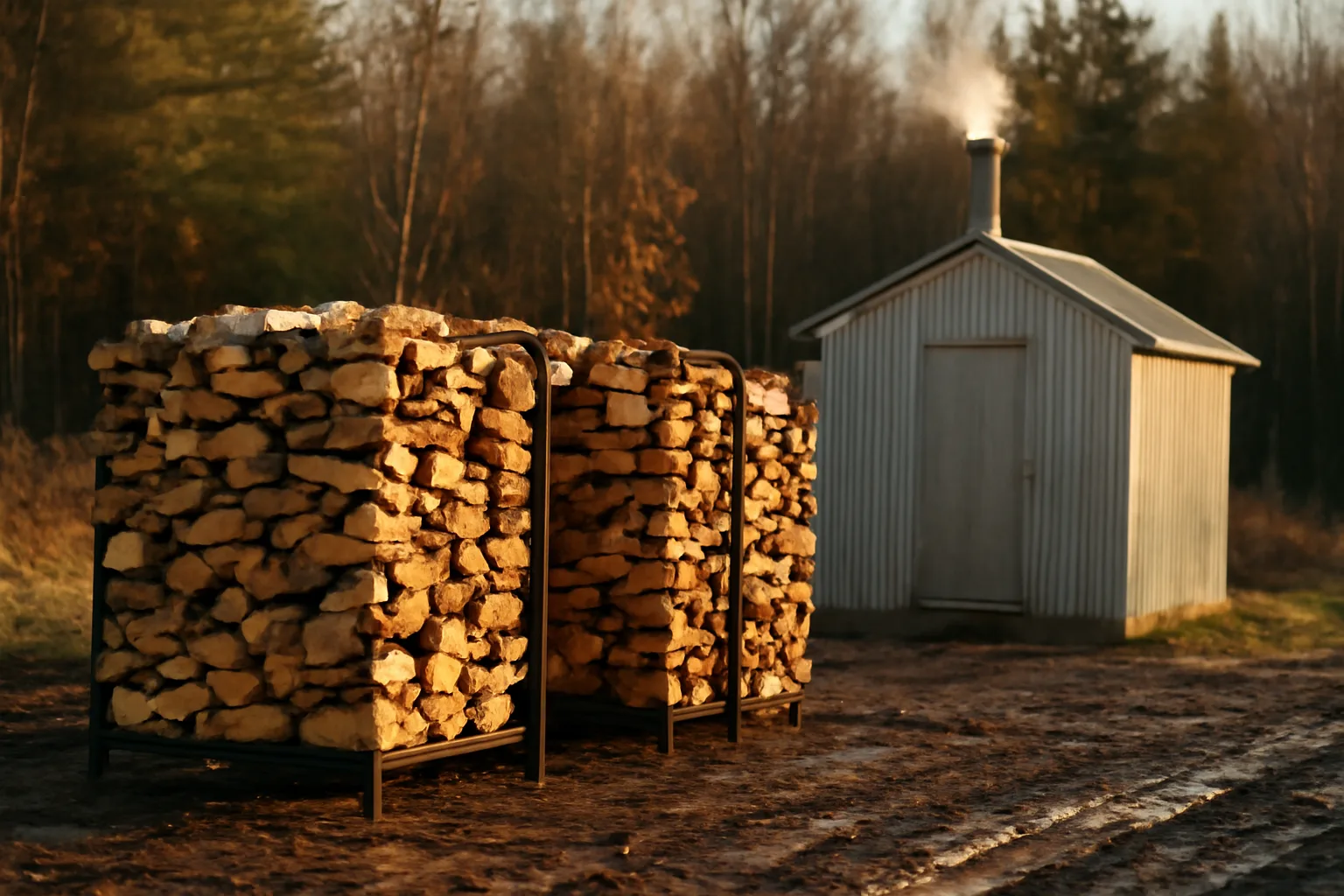
TL;DR
Kiln firewood is split fuelwood dried in a heated chamber, usually to 20 percent moisture or less, the EPA dry-wood target. You start by confirming land use, registering a real business, following cord method-of-sale rules, and documenting heat if you ship. There is no federal kiln firewood license. Confirm forms with your state board.
What is kiln firewood?
Kiln firewood is split fuelwood dried in a heated chamber until it burns clean, usually at or under 20 percent moisture. That 20 percent figure comes from EPA burn guidance, not a marketing slogan. [1] The kiln is a process. The product is still firewood.
People confuse this with kiln-dried lumber. Lumber kilns follow Forest Products Laboratory schedules built for boards and structural stock. [8] A firewood kiln is often a converted container, a dehumidification box, or a small chamber that pushes hot air through ranked splits. You are dropping water weight and, if you ship, showing a kill step for insects.
Air-dry on pallets for a season and you have seasoned wood. Force heat, meter the core, and (when a plant board asks) log a time and temperature, and you have kiln firewood. Buyers pay more because it lights faster and throws less water into a stove. EPA is blunt that wet wood wastes fuel. [1]
I would not stamp a pile "kiln-dried" because it sat next to a space heater. If you cannot meter the center of a split, you are guessing. Guessing is how you eat refunds.
Kiln firewood is also not automatically legal to move. Heat can dry wood and still fail a state's pest rule if you never recorded core temperature. Drying and phytosanitary treatment overlap. They are not the same paper.
How do you start kiln firewood?
You start kiln firewood by treating it as a packaged-goods business on land you are allowed to use, not a hobby pile with a heater. Register the entity, get a sales tax account if your state taxes firewood, confirm zoning for a kiln and outdoor storage, then pick a drying method you can document. There is no single federal kiln firewood license.
Walk the paper in this order. First, land use. A kiln is noisy, it vents moisture, and it looks industrial to a neighbor. Get the zoning answer in writing before you buy steel. Second, business identity. The SBA's launch guide is dull and correct: licenses and permits are state and local, and you apply before you advertise. [10] Third, method of sale. Firewood sells by the cord (128 cubic feet ranked and well stowed) or a stated fraction, never by "a load." [2] Fourth, tax and weights and measures. Fifth, pest rules if any stick leaves your county.
I would not start by ordering a $40,000 computerized lumber kiln. That is a common waste of money in month one. A used dehumidifier box or a well-baffled container can prove the product while you learn cycle time. Spend first-year cash on a decent moisture meter, pallets, racking, and a way to keep rain off the outfeed. The kiln is useless if the dry wood sits uncovered.
State paths differ. If you are actually filing, read a state walkthrough rather than a national myth. Start with how to start kiln firewood in Alabama, how to start kiln firewood in California, or how to start kiln firewood in Alaska. Those pages track board-confirmable steps. This guide does not.
Source wood legally. Stolen roadside oak is not a business model. If you cut on your own land, keep the deed and any timber paperwork your county uses. If you buy logs, keep load tickets. Plant boards and insurance adjusters both ask where the fiber came from after something goes wrong.
Do not promise a customer a ship date until you have run three full kiln cycles and metered the core. Cycle time is species, diameter, starting moisture, and how badly your chamber leaks. Nobody has one national number. The closest honest analog is lumber drying research, which varies by thickness and species. [8]
What moisture content should kiln firewood hit?
Aim for 20 percent moisture or less, measured in the core of a split, because that is the dry-wood target EPA uses for cleaner burning. [1] University of Minnesota Extension names the same threshold for efficient burning. [3] Under 20 percent is the claim I would print on a label. Under 15 percent is a nicer burn and a longer kiln cycle. Chasing 8 percent on oak splits usually just wastes propane.
Meter the center, not the face. Freshly split faces dry first and lie. Drive pins into a freshly cracked face from the middle of a piece that finished the run. Log species, date, kiln ID, and the reading. If a buyer disputes "kiln-dried," that notebook is the whole case.
EPA tells households to burn dry wood and ties wet wood to wasted heat and creosote. [1] [14] You are selling into that advice. Sell 28 percent wood with a kiln story and you are selling wet wood.
Colorado State Extension and other land-grant pages still measure seasoning in months, not hours, when there is no kiln. [12] A kiln compresses that clock. It does not repeal physics. Thick rounds take longer than thin splits. Mix species in one charge and you will overdry the ash while the elm is still wet. I would sort charges by species and by split size.
Want a single packet that walks moisture method, cord stacking language, and HOA notice letters? The FirewoodPath Moisture + Cord + HOA Kit is a $129 one-time kit. You do not need it to run this process. A $30 meter and a lab notebook already beat most competitors.
Is kiln dried firewood the same as seasoned wood?
No. Seasoned firewood is air-dried, often six months or more, until moisture falls. Kiln firewood is force-dried with heat (and sometimes dehumidification) on a clock you control. Both can hit 20 percent. Only one gives you a dated kiln chart.
EPA still tells households to season wood and stay at or under 20 percent moisture. [1] That guidance does not require a kiln. A careful air-dry pile in a windy yard can beat a leaky homemade kiln. I have more respect for a metered, covered, six-month stack than for a "kiln" that never broke 110 F in the core.
The sales difference is speed, winter inventory, and (sometimes) pest paperwork. You can sell in August wood that was green in June. You can also oversell. "Kiln-dried" is not a protected federal grade for firewood the way USDA grades meat. Claim it, and be ready to show numbers.
Heat-treated firewood is a third category. A charge can be heat-treated to a plant-board schedule and still run wetter than you want for burning. A charge can be bone dry and still be illegal to import into a state that wants a labeled treatment. Wisconsin's invasive-firewood page treats certified heat-treated wood as a pest tool, not a BTU grade. [6]
| Claim on the bag | What it usually means | What I would require before I paid |
|---|---|---|
| Seasoned | Air-dried some months | Core moisture at or under 20% |
| Kiln-dried | Forced heat or dehu | Meter log plus species |
| Heat-treated / certified | Pest kill schedule | Kiln chart the receiving state accepts |
Do you need a license to sell kiln firewood?
You need whatever business, tax, land-use, and weights-and-measures permissions your state and town already use for retail fuelwood. You do not get a special federal "kiln firewood license." USDA APHIS does not hand out a national firewood seller card. [7]
Typical paper, in plain language: a state business registration, a sales tax permit if firewood is taxable where you sell, a local zoning clearance for processing and outdoor storage, and compliance with the method of sale for firewood. Some towns want a home-occupation permit. Some counties want a weighmaster or a device inspection if you sell by weight. Confirm with the relevant board. Do not trust a Facebook group for the fee.
Pest certificates are separate. Sell inside a tight local radius and many states leave you alone beyond the untreated-move limits. Advertise "statewide delivery" or ship on a pallet, and you are in plant-health territory. New York is the example people still underestimate. Untreated firewood cannot be imported, and untreated wood has a 50-mile move limit from its source. [5]
License titles vary. Alabama's path is not California's path. Read kiln firewood license in Alabama or kiln firewood license in California if that is where you will file. For Alaska's thinner market, use kiln firewood license in Alaska. Those are state paper maps. This section is not.
I would call the state plant board and the county zoning desk before I printed labels. Two 20-minute calls. Cheaper than repainting a kiln you cannot run.
How should you measure a cord of kiln firewood?
Sell kiln firewood by the cord or a stated fraction of a cord unless your state's weights and measures office has a written exception. NIST Handbook 130, the uniform method-of-sale text most states adopt, treats a cord as 128 cubic feet when the wood is ranked and well stowed. [2] University of Minnesota Extension describes the same stack: 4 feet high, 4 feet wide, and 8 feet long. [3]
"Ranked and well stowed" means stacked as tightly as practical, not thrown in a truck bed and called a cord. A pickup heap is not a measurement. Sell "face cords" or "racks" and you print the exact dimensions. A face cord 16 inches deep is one-third of a full cord only if height and length match the 4 by 8 face. Most fights at the driveway are about that math.
Kiln drying shrinks the pile. Water left. The stack you loaded at 45 percent moisture is smaller at 18 percent. Pre-sell by the green cord, deliver a dry stack, and you look short. I would sell by the dry, stacked cord at the outfeed, and I would let the customer see the rank.
Keep a photo of each delivery against a tape or a painted 4 by 4 by 8 frame. Cheap. Effective. Weights and measures complaints are not theoretical. They are how small firewood sellers get fined.
Do not sell by the "truckload" as your primary unit. It is how you lose arguments. If a customer wants a partial load, invoice a fraction of a cord with dimensions on the ticket.
What heat treatment do pest rules actually require?
Pest rules ask for a documented core temperature held for a stated time, not the word "kiln" on your website. Federal plant-health treatments live in 7 CFR part 305 and the PPQ Treatment Manual those regulations point to. [11] ISPM 15 is the international heat standard for wood packaging material (a 56 C core for 30 minutes in the current standard). [13] Firewood is not wood packaging. Do not buy an ISPM 15 stamp kit and assume you can ship bundles nationwide.
State firewood schedules often run hotter or longer than ISPM 15. Wisconsin describes certified heat-treated firewood as wood heated to a core of at least 140 F for 60 minutes (some programs publish 160 F for 75 minutes). [6] New York bans untreated imports and limits untreated movement to 50 miles from the source. [5] USDA Forest Service advice to campers is still "buy it where you burn it." [4]
APHIS public guidance is built around not moving firewood because pests hitchhike in bark and sapwood. [7] Your kiln can be part of the answer. Only if you record probes in the core, not in the air stream. Air at 180 F with a wet 8-inch round in the middle of the stack is how people fake a treatment.
I would call the destination state's plant board before the first pallet leaves. Ask what label text they want, whether they recognize another state's certificate, and whether a kiln chart plus invoice is enough. Render every fee and processing time as "confirm with the board." Nobody here can honestly quote a current certificate price.
Quote the New York rule in your own head before you offer "we ship anywhere": untreated firewood is not a casual interstate SKU. [5]
What equipment is worth buying in year one?
Buy a moisture meter you trust, splitting capacity that matches your wood, racking that lets air move, a cover for dry outfeed, and the smallest kiln that can finish a marketable charge. That is the year-one kit. Fancy controls can wait.
A pin meter that reads core wood is not optional if you claim kiln-dried. Infrared guns read surface. Useless for this. I would rather see a $40 pin meter used every charge than a $4,000 controller nobody logs.
Kiln choice is a fork. Dehumidification kilns are gentler and cheaper to run in mild weather. Hot-air or gas kilns are faster and harsher on ends. Converted shipping containers work if you baffle them and probe the core. They waste heat if you do not. I would not pour a slab for a commercial lumber kiln until I had sold 50 dry cords and knew my species mix.
OSHA's sawmill standard (29 CFR 1910.265) is the text to read once your yard starts looking like a mill: dry kilns, conveyors, lockout, and woodworking hazards. [9] A two-cord backyard box is not a sawmill. A site with a processor, a conveyor, and a walk-in kiln might be. Read the standard. Do not assume you are invisible.
Skip the custom bagging line until grocery accounts exist. Skip the branded wrapping paper. Customers buy dry wood that is honest on the cord. Everything else is theater.
Kiln cost is all over the map because people count a $900 used dehumidifier and a $60,000 package plant as the same word. For a sense of how state cost writeups handle this without fake quotes, see kiln firewood cost in Alabama and kiln firewood cost in Alaska. Confirm vendor quotes yourself.
Can you ship kiln firewood across state lines?
Sometimes, if the receiving state accepts your treatment and label. Not because you own a kiln. USDA's public line is still that moving firewood moves pests. [7] Forest Service campground advice is to buy firewood where you burn it. [4] Those are not vibes. They are how inspectors think.
New York is the hard example because the rule is easy to quote. The Department of Environmental Conservation states that it is illegal to import untreated firewood into New York, and that untreated firewood may not be moved more than 50 miles from its source. [5] If your marketing copy says "we ship the Northeast," you need a treatment certificate path, not a hope.
Wisconsin and other Great Lakes states run certified firewood lists for heat-treated product. [6] Certification is a program. It is not a sticker you print at home. Ask the program what probe placement, kiln diagram, and lot coding they want. Then do that, every charge.
Federal treatment regulations in 7 CFR part 305 tell you treatments must follow the PPQ Treatment Manual. [11] That manual is for regulated articles. Your state plant board will tell you whether firewood you produce is a regulated article when it crosses their line. I would not self-declare.
Local delivery inside one metro is the clean business. Interstate e-commerce firewood is a paperwork business that happens to include wood. Price it like paperwork.
What first year paper should you keep?
Keep land-use approval, business registration, tax accounts, wood source tickets, kiln charge logs, moisture readings, delivery tickets with cord dimensions, and any plant-board certificates. That stack is the first-year operations file. If it is not written, it did not happen.
A usable kiln log is boring. Charge number, species, split size, load date, start moisture, probe IDs, time the core hit the target, time it held, end moisture, unload date. If you chase a heat-treatment certificate, the hold time is the whole point. [6] [11]
Delivery tickets should show the unit (cord or fraction), stack dimensions, moisture claim if you made one, and the address. NIST's method-of-sale logic is what a weights and measures inspector will pull up. [2]
Source tickets matter when someone alleges you cut a neighbor's trees or moved emerald ash borer. APHIS did not build a public campaign against firewood movement for fun. [7] Your invoice trail is how you show the wood was local, treated, or both.
I would keep the file at least as long as your state keeps tax records, and longer if you ship. Cloud folder plus a paper binder in the shop. Kilns eat laptops.
Do not invent a processing time for certificates in that binder. Write "pending, confirm with the board" until the letter arrives. No approval guarantees.
What insurance and land rules hit kiln firewood?
You need permission to run a noisy, venting heat source and to store combustible fiber outdoors, plus liability cover that assumes someone will burn what you sold. Zoning first. Insurance second. Both are local. The SBA reminder still holds: licenses and permits are not one federal form. [10]
HOAs and rural zoning fight kilns for different reasons. HOAs hate visual mess, truck traffic, and smoke if you burn offcuts. Counties hate setbacks, commercial activity on residential lots, and fire load. Get the answer in writing. A handshake with one board member is not a permit.
If you process on-site, think about OSHA once the site grows past a chainsaw and a box. 29 CFR 1910.265 is the sawmill text, including kiln-related industrial hazards. [9] General industry rules still cover fuel gas, electrical, and walking-working surfaces even if the sawmill standard does not fit. I am not your safety lawyer. Read the standard.
Liability is the stove on the other end. Wet wood and chimney fires live in the same stories. EPA ties wet wood to wasted heat and buildup in the flue. [1] [14] Your moisture log is a defense. A verbal "it's kiln-dried, trust me" is not.
I would carry general liability and, once you have employees or a mill-like yard, look at the cover your agent actually uses for wood processing. Confirm exclusions for pollution and for off-site delivery. Do not assume a homeowner policy silently covers a commercial kiln.
How long does kiln drying take?
It depends on species, starting moisture, split thickness, and whether your chamber actually holds heat. There is no honest national cycle time for kiln firewood. Anyone who sells you "48 hours, every load, every species" is selling a slogan.
The closest published science is lumber drying, not firewood marketing. The Forest Products Laboratory Wood Handbook lays out that drying time varies with thickness, species, and schedule. [8] A 16-inch oak round is not a 4/4 board. It will take longer. Split that oak to stove length and you win days back.
Air seasoning still takes months in extension guidance when you have no kiln. Colorado State Extension's firewood page is in that camp. [12] A working kiln compresses months toward days or a couple of weeks. Your meter decides when the charge is done, not the calendar.
I would run test charges of one species, one size, and log every hour until the core sits under 20 percent. [1] [3] Then you have a schedule for that box. Copying a YouTube cycle from a different climate is how you unload wet maple and call it dry.
Hold time for pest treatment can be shorter than the time needed to dry. You may hit 140 F in the core for 60 minutes and still be too wet to sell as a premium burn. [6] Finish the moisture. Then, if you need the certificate, make sure the hold was recorded while the wood was actually at temperature.
Frequently asked questions
What is kiln firewood?
Kiln firewood is split fuelwood dried in a heated chamber, usually to 20 percent moisture or less, which is EPA's dry-wood target. It is still firewood. The kiln is how you remove water on a clock you control. Heat treatment for pests is a separate claim and needs its own temperature hold and label if a state requires it.
How do you start kiln firewood?
Confirm zoning for a kiln and outdoor storage, register the business, set up tax and method-of-sale compliance for the cord, then dry wood you can meter and document. There is no federal kiln firewood license. If you will leave your local radius, call the plant board before you advertise shipping. Confirm every form and fee with the board that issues it.
Is kiln-dried firewood safer for chimneys than green wood?
Drier wood burns cleaner and is less likely to dump water and extra creosote into a flue, which is why EPA pushes 20 percent moisture or less. Safer is not the same as safe. Stove use, flue condition, and species still matter. I would still tell buyers to follow the stove manual and to meter a split if they do not trust the bag.
Do I need a USDA stamp on every bundle?
No. There is no universal USDA firewood stamp for retail kiln firewood. ISPM 15 marks are for wood packaging material, not for stove wood. Some states run their own heat-treated firewood certificates and labels. Ask the destination plant board what mark they want before you print anything.
Can I use a homemade shipping container kiln?
Yes, people do, if zoning allows it and you can probe the core and keep a log. Containers leak heat if you skip baffles. I would run test charges and throw out any cycle that cannot hold the core temperature you claim. A container is not automatically a certified treatment chamber.
How do I prove moisture content to a buyer?
Split a finished piece, meter the fresh core, and keep a charge log with species, date, and reading. EPA and extension pages both treat about 20 percent as the dry target. Surface readings lie. If you claim kiln-dried, the notebook is the product.
Does an HOA or zoning rule block a firewood kiln?
It can. Kilns make noise, trucks, steam, and a commercial look. Get written zoning or HOA clearance before you set steel. A verbal okay from one neighbor is not a permit. If the lot is residential, assume you need a conversation, not a surprise.
Is a moisture meter required by law?
Usually no statute says "thou shalt own a meter." Method-of-sale rules care about volume. Pest rules care about heat. Buyers and EPA guidance care about 20 percent moisture. If you print kiln-dried on a label, a meter is how you avoid a false claim. I would not operate without one.
Can I sell kiln firewood by the truckload instead of the cord?
Not as your legal unit in states that adopted NIST Handbook 130 method of sale. A cord is 128 cubic feet ranked and well stowed. A truckload is a vehicle, not a measure. Invoice cords or stated fractions with dimensions. You can still deliver in a truck.
What records do plant boards want for heat treatment?
Typically a kiln diagram, probe placement in the core, a time and temperature chart for each lot, species or product description, and a label the program already approved. Wisconsin-style certification is a program, not a DIY sticker. Confirm the current checklist with that board. Do not guess hold times from a blog.
Do I need a weighmaster license to sell kiln firewood?
Only if you sell by weight and your state treats that as a weighmaster activity. Most firewood is sold by the cord (volume). If you advertise tons or pounds, call weights and measures before the first ticket. Confirm whether your platform scale even needs inspection.
How do I label kiln firewood for interstate sale?
Use the receiving state's required treatment statement, origin, and lot code, not a generic "kiln-dried" claim. New York treats untreated imports as illegal and limits untreated moves to 50 miles from source. Other states keep certified lists. Ask that plant board for specimen label text. Confirm before you print a run of bags.
Sources
- U.S. EPA, Best Wood Burning Practices (Burn Wise): EPA burn guidance treats dry, seasoned wood as having a moisture content of 20 percent or less.
- NIST Handbook 130 (2023), Uniform Laws and Regulations (method of sale): A cord is 128 cubic feet of wood when ranked and well stowed; firewood is sold by the cord or a fraction of a cord.
- New York State DEC, Firewood and Invasive Pests: It is illegal to import untreated firewood into New York; untreated firewood may not be moved more than 50 miles from its source.
- Wisconsin DNR, Firewood Restrictions and Certified Firewood: Certified heat-treated firewood is described as heated to a core of at least 140 F for 60 minutes (state certification programs).
- OSHA, 29 CFR 1910.265 Sawmills: OSHA's sawmill standard addresses mill-like sites, including dry kiln and woodworking hazards.
- U.S. Small Business Administration, Apply for licenses and permits: Business licenses and permits are issued at state and local levels; you apply before operating.
- eCFR, 7 CFR Part 305 (Phytosanitary treatments): Federal phytosanitary heat treatments must be administered in accordance with the PPQ Treatment Manual.
- IPPC, ISPM 15 (Regulation of wood packaging material): ISPM 15 heat treatment (56 C core for 30 minutes) applies to wood packaging material, not as a retail firewood license.