Last updated 2026-08-21
TL;DR
Kiln firewood is split wood run through a kiln to drop moisture, kill pests, or both. EPA wants burn wood at 20% moisture or less. APHIS heat treatment is 60°C (140°F) for 60 minutes at the center. Start with zoning and a legal cord, then state ag paper if you ship. Confirm every fee with the board that collects it.
What is kiln firewood?
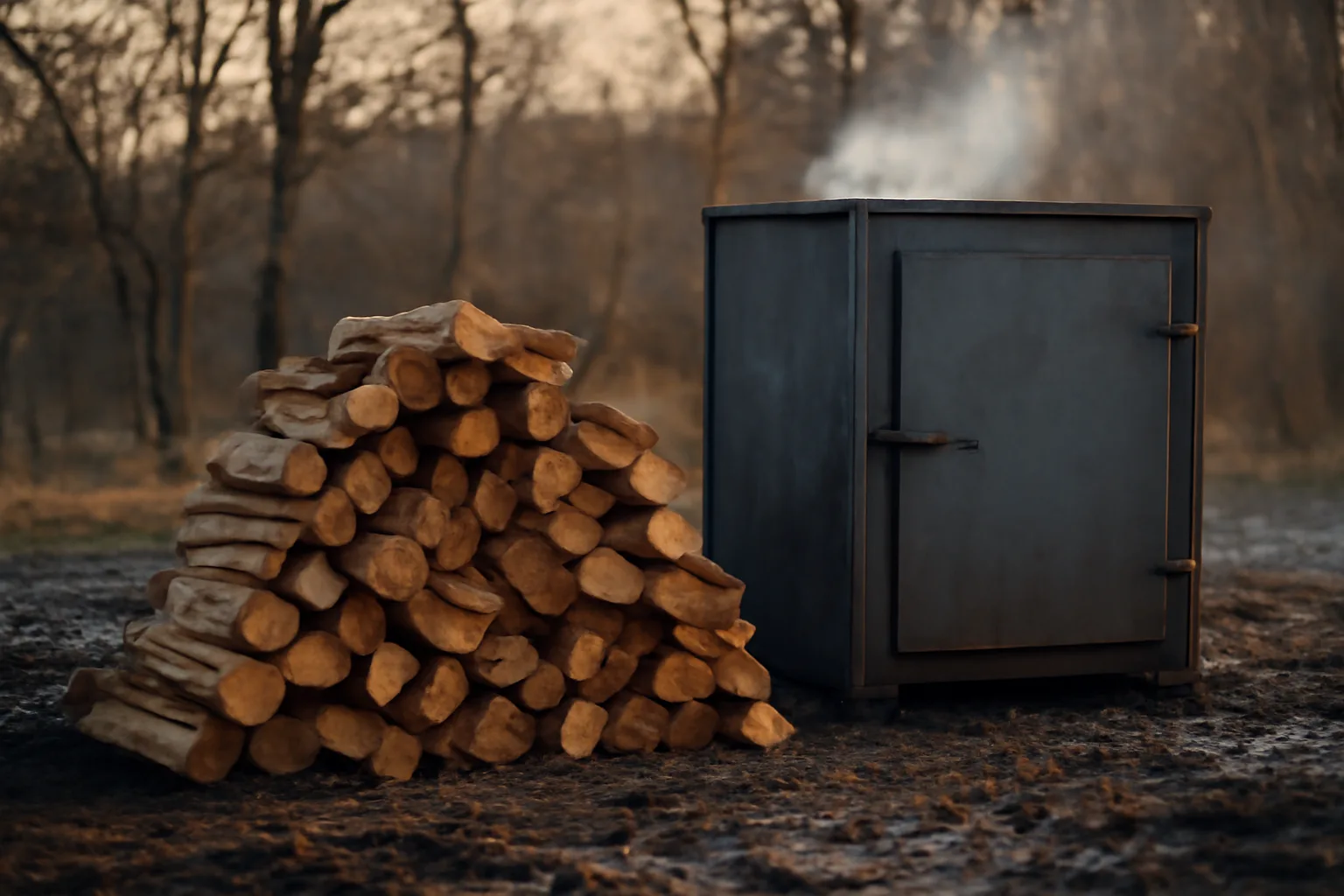
Kiln firewood is split firewood that spent time in a heated chamber so it dries faster, hits a pest-kill temperature, or both. It is not a federal grade. Buyers use the phrase for wood under 20% moisture, wood that held 60°C for 60 minutes at the core, or wood that did both. Ask which one you are buying.
A kiln is a box with heat, airflow, and a way to dump water. Yards use converted containers, dehumidification rooms, or waste-heat chambers off a mill. You still split first. Rounds do not treat or dry evenly. Thin splits move faster. That is heat transfer, not branding.
Two jobs get mixed together. Drying cuts the water so the stick lights and puts heat in the room. Heat treatment raises the core long enough to kill insects that ride in bark and sapwood. You can treat without finishing the dry-down. You can dry without ever logging a 60 minute hold. Say which job you did.
EPA burn pages point people at wood with a moisture content of 20% or less. [1] That number is about smoke and heat, not about beetles. APHIS firewood heat treatment is a center temperature of 60°C (140°F) for 60 minutes. [2] Different probes. Different logbook lines.
Green hardwood often sits well above 40% moisture. Air seasoning in a covered, off-ground rick still takes many months. A kiln shortens the calendar. It does not repeal weather, species, or sloppy stacking. I would not pay a kiln premium to a seller who cannot show a split-open reading from the day of delivery.
How do you start kiln firewood?
You start kiln firewood by locking land use, then the legal unit of sale, then heat and moisture records, then any state agriculture paper if the wood will leave your area. There is no national kiln firewood license. Confirm every form with the board that stamps it. Fees and names change. I will not invent them.
Site first. Zoning and the fire marshal beat any kiln ad. A burner plus a wood pile is a use. Neighbors notice smoke and trucks. If an HOA sits on the deed, read the covenants before you pour concrete. More first yards die on a complaint than on a wet rick.
Then the unit. States that follow NIST Handbook 130 sell firewood by the cord or a fraction of a cord. A cord is 128 cubic feet of stacked wood. [3] "Truckload" without a cube is how you meet weights and measures. Get the method of sale in writing from your state metrology people.
Then process control. A moisture meter you use, probes that reach the center of a thick split, and a logbook. Date, species, start moisture, peak core temp, hold time, end moisture, bay number. That log is the product.
If wood will cross a quarantine line or land on a state park rule, call the plant board before you take a deposit. New York restricts untreated import and long hauls. [4] Wisconsin limits firewood on DNR land unless it comes from an approved source. [5] Read this year's memo. Last year's blog post is not a permit.
Year-one cash should go to splitting capacity, a kiln you can weld yourself, rails to keep wood off dirt, a roof, insurance, and fuel. Skip the bagging line. Sell local. Dry a share in the kiln. Air-dry the rest. Hybrid yards eat fewer bad months.
Land and permit money is not the same in every state. Compare a southern stack like kiln firewood cost in Alabama with a western one like kiln firewood cost in Arizona or kiln firewood cost in California before you copy a YouTube budget.
Is kiln-dried firewood the same as heat-treated firewood?
No. Kiln-dried means the load dried in a kiln. Heat-treated means the core hit a documented temperature for a set time. A pallet can be one, the other, or both. Pay for the schedule and the moisture number, not the adjective on the bag.
A lot of retail "kiln dried" firewood is really heat-treated and still sitting in the high 20s for moisture. It may be legal to move. It may still hiss in a stove. The inverse happens too. A dehumidification kiln can pull wood to 15% without a pest certificate anyone will accept at a state park gate.
If you sell across a line, the receiving state decides what treated means. Some want a USDA schedule, some want a state compliance agreement, some want a vendor list. Maine runs an external firewood quarantine and treated exceptions. [6] After APHIS removed the federal emerald ash borer domestic quarantine, states kept their own firewood rules. The Federal Register notice says "APHIS is removing the domestic quarantine regulations for the control of emerald ash borer (EAB)." [8] Do not tell a customer the federal government cleared their trunk.
I print both numbers on the invoice. Moisture. Core hold. If I only have one, I say so.
What moisture content should kiln firewood hit?
Aim for 20% moisture or less if you are selling kiln firewood people will burn this week. That is the EPA burn target, not a poetry line. [1] EPA's wet-wood factsheet treats wet wood as wasted heat and extra smoke. [13] A kiln load at 25% is better than last week's green ash. It is not dry.
Use a pin meter on a fresh split face, not the sun-baked outside. Take three sticks from the middle of the pack. Log the high reading, not the pretty one. Species fool you. Oak lies. Pine fools you the other way.
The U.S. Department of Energy states, "A cord of wood generally contains about 20 million Btu." [7] That figure assumes burnable wood, not a sponge. Water has to boil off before the stick gives you that heat. That is why wet wood feels like a cheat even when the pile looks gray.
University of Minnesota Extension walks through what to burn and why dry hardwoods carry more usable heat per cord than wet or punky wood. [10] I keep their species notes on the phone when a new customer asks why hickory is priced like it is.
Nobody has a clean national dataset on what kiln-dried retail packs actually measure at the curb. The closest honest practice is to meter every batch and refuse the premium if you missed.
What temperature and time does a firewood kiln need?
For pest paperwork, plan on a 60°C (140°F) core hold for 60 minutes, which is the APHIS firewood heat treatment schedule most boards still point to. [2] For drying only, you can run cooler and longer. Cooler air still pulls water if you vent. It may not satisfy a quarantine officer.
Place probes in the thickest splits, in the coldest part of the charge. The corners of a container kiln lie. The door wall lies. If the probe sits in a crack, you will record fantasy.
Lumber kiln schedules from the Forest Products Laboratory are written for boards, grades, and stain, not for a rick of oak. [9] Steal the physics (wet-bulb, airflow, equalize) and do not pretend FPL published a firewood recipe with your species and your box. I have not seen a peer-reviewed national firewood kiln schedule that matches backyard containers. Closest work is lumber drying handbooks and extension burn pages.
Hold time starts when the coldest probe hits the target, not when the furnace is loud. Write that rule on the kiln door. Your future self will try to cheat it on a Friday.
Do you need a license to sell kiln firewood?
You do not get a federal kiln firewood license. You collect a pile of ordinary paper that your county, state weights and measures shop, tax department, and sometimes the plant board already know how to issue. The list is local. Confirm it. I will not quote a fee I cannot see on this year's board page.
Typical first-year stack, in plain language: a business registration or DBA, a sales tax permit if your state taxes firewood, a weights and measures device or method-of-sale review if you sell by volume, zoning or a home-occupation clearance, and a burn or air permit if your kiln stacks smoke in a restricted county. If you employ anyone, add the usual labor filings. If you only sell a few cords to neighbors, some of that still applies. Hobby is not a legal shield.
Plant paperwork is separate. Heat-treat for export out of a quarantine and you may need a compliance agreement or a state-certified facility number. Parks and forests often only accept firewood from a published vendor list. [5][6]
Insurance is not a license and you still want it. A kiln fire and a delivered ember claim are not theoretical.
If you want a single checklist for moisture, cord math, and HOA reading, FirewoodPath sells a $129 one-time Moisture + Cord + HOA Kit. Use it or build your own folder. The folder is the point.
How do you measure a cord of kiln firewood?
Sell kiln firewood by the cord or a stated fraction of a cord unless your state metrology lab wrote you a different legal method. NIST Handbook 130 treats a cord as 128 cubic feet of stacked wood. [3] A face cord or rick is not a cord. Say the stack size in feet.
Penn State Extension still teaches the 4 by 4 by 8 picture and how to season and measure without theater. [11] Measure the pile, not the truck bed. Air space is part of a stacked cord. A thrown pile in a dump trailer is not a stacked cord. If you sell thrown, say thrown cubic feet and know your state's rule. Some states hate that.
Kiln-dried wood shrinks. If you stack wet, kiln it, and deliver the same cord outline, you may have sold less wood. I restack after the kiln or I sell by a counted, strapped bundle with a posted cubic measure. Pick one method and print it.
Do not stamp 4.2 cubic feet on a bag unless you can defend it with a case count and a scale ticket if they ask for weight. Some jurisdictions allow sale by weight. Most consumers still think in cords. Match the law, then match the customer's language in parentheses.
Can you haul kiln firewood across state lines?
Sometimes, if the receiving state accepts your treatment records or if both ends have no extra firewood rule. Never assume a kiln sticker on a bag is a passport. Call the destination plant board. Get a name. Write the date.
New York's firewood regulation is the example I send people because the paper is public and blunt. Untreated firewood stays close to its source and does not come in from outside the state without treatment. [4] Maine's external firewood quarantine is another board-written rule, not a meme. [6] Wisconsin's DNR land rule is about what you may bring onto those properties, which is a different gate than a private driveway. [5]
The federal EAB domestic quarantine is gone. APHIS said so in the December 15, 2020 Federal Register rule that removed those regulations. [8] State and land-manager rules stayed. "It's legal federally" is a half sentence.
If you run regular routes, keep a binder per destination state. One missed park ranger conversation is cheaper than a dumped load.
Costs and permit culture also shift when you compare kiln firewood cost in Colorado, kiln firewood cost in Connecticut, and kiln firewood cost in Florida. Use those pages for the local cost shape, then confirm live numbers with the board.
What equipment do you actually need in year one?
You need a way to split, a way to heat and vent a closed charge, a way to meter moisture, a way to move pallets, and a roof. That is the year-one list. Everything else is ego.
A used 20-ton splitter beats a new processor you will finance into a bad winter. A container kiln with a used furnace you can get parts for beats a turnkey system with one technician in another time zone. Two pin meters beat one fancy meter you are afraid to drop.
Rails, pallets, or poles keep the intake off soil. Soil water undoes a kiln week. I would rather spend on gravel and used pallet rack than on a logo wrap.
If you mill, read OSHA's sawmill standard at 29 CFR 1910.265 and do not pretend a firewood bench is exempt from guards, dust, and noise common sense. [12] A yard with only a splitter still has thrown wood, saws, and fuel. Train whoever stands next to the wedge.
Skip bagging machines, retail storefronts, and custom sheds until you have sold through a full heating season. Inventory lies in April.
For long-haul states, freight dominates the budget. See kiln firewood cost in Alaska before you promise a shipped cord.
How long does kiln drying firewood take?
A small firewood kiln often cycles in 24 to 72 hours for already split, partly dry wood, and longer for green thick oak. That is a practitioner range, not a lab constant. Starting moisture, species, split size, outdoor temperature, and whether you equalize overnight all move the clock. Anyone who sells you a guaranteed 18-hour green-oak cycle is selling a brochure.
Air seasoning still takes most of a year in many climates. Penn State describes multi-month seasoning for stacked, covered wood. [11] Colorado State Extension's firewood page is the high-country version of the same physics, with species heat notes. [14] A kiln's job is to crush that wait for the fraction of inventory you need next week.
I run mixed charges less often than YouTube does. Oak with pine is a mess of different end points. Batch by species and thickness. Your probes will thank you.
If the charge comes out of the kiln hot, let it equalize under cover. Pulling steaming wood straight to a wrapped pallet traps the last water at the surface. That is how you get mold on dry bags.
Air-dried vs kiln firewood, which should you sell first?
Sell air-dried local wood first if your climate and your yard space allow a 6 to 12 month stack. Add a kiln when customers pay for last-minute dry wood, when you need movement papers, or when rain never lets a rick finish. Do not buy a kiln to feel official.
Air-dried hardwood, stacked off the ground and covered on top only, still makes excellent heat. University burn pages have said this for decades. [10][11][14] Kiln firewood wins on calendar, pest paperwork, and consistent moisture. It loses on fuel cost, labor, and the chance you will overdry and raise breakage.
I would not kiln every stick in year one. Kiln the rush orders and the crossing-the-line orders. Let the rest sit. Your propane bill will explain why.
Missouri Extension's selling-firewood publication is old-fashioned and useful on pricing, measure, and not promising what you cannot deliver. [15] Read it before you print a menu.
What first-year paper should you keep?
Keep a kiln log, moisture sheets, invoices with a stated volume, source records for the trees or loads, zoning or HOA letters, tax filings, and any plant-board emails that say you are allowed to move treated wood. Keep them longer than you think. A winter complaint arrives in March.
Source records matter if someone asks whether the ash was local. "I bought a log truck" is not a chain of custody. Tickets, landowner names, and dates are.
Weights and measures cares about the cord statement. The plant board cares about the treatment statement. The tax office cares about the dollar statement. Do not merge those sentences into one cute slogan.
Confirm retention periods with your accountant and your state. I am not your lawyer. FirewoodPath is an independent publisher, not a law firm and not a service company. Variable fees, quotas, and processing times belong on the board's current page, not in a guide with a date stamp.
If you want a start page after you finish this article, use /start. That is a kit and checklists, not an approval.
What wastes money when you start a kiln yard?
Turnkey kilns you cannot repair, bagging lines, retail rent, underpriced delivery, and treating every stick when half your buyers live 8 miles away. Those are the year-one holes.
Buying logs at retail firewood prices and then kilning them is another hole. You cannot add enough value. Buy standing, buy tree-service rounds, or buy mill ends. Know the difference.
Undersized electrical service and a later-burner plan waste months. Size the heat to green oak in January, not to a clip shot in June.
Skipping insurance to save a month of premium is not toughness. It is a bet against fire.
Copying another state's cost stack is how people underprice. Read kiln firewood cost in Georgia and then call your own county. Confirm the live number.
Frequently asked questions
What is kiln firewood?
Kiln firewood is split firewood that went through a heated chamber to dry faster, to hit a pest-kill core temperature, or both. It is not a USDA grade. Ask for a moisture number and, if you need movement papers, a 60°C for 60 minutes core-hold record. A sticker alone is not a definition.
How do you start kiln firewood?
Lock zoning and fire-marshal rules first, then the legal cord, then kiln logs, then any state plant-board paper if wood will leave your area. There is no national license. Confirm forms and fees with the office that stamps them. Year one is splitting capacity, a repairable kiln, off-ground storage, and insurance, not a bagging line.
Is a permit required for a backyard firewood kiln?
Often yes, even if you never hang a sign. Zoning, home-occupation rules, HOA covenants, and sometimes an air or burn permit can all apply to a box kiln and a wood pile. The list is local. Call planning and the fire marshal before you buy a used container. Confirm the current form names with those boards.
Can I sell kiln firewood by the truckload?
Only if your state metrology lab allows that language and you still state a legal volume. NIST Handbook 130 treats firewood as a cord (128 cubic feet) or a fraction of a cord. A truck bed is not a unit. Print stacked feet or a counted bundle size. Confirm the method of sale with weights and measures.
Does kiln firewood stop emerald ash borer?
A documented 60°C (140°F) core hold for 60 minutes is the APHIS heat-treatment schedule boards still use for firewood pests. Drying alone is not the same test. The federal EAB quarantine is gone, but state and park rules remain. Treatment records matter more than the word kiln on a bag.
How dry is too dry for kiln firewood?
EPA burn guidance wants 20% moisture or less. Going into the low teens is fine for lighting. Bone-dry, rattling splits crack, throw sparks, and break in the bag. I stop when the batch meters at or under 20% on a fresh split face and still handles without crumbling. Overdrying wastes fuel.
Do I need a phytosanitary certificate for in-state sales?
Usually no, if the wood stays inside one state's ordinary commerce and off restricted public land. Parks, state forests, and a few in-state quarantine zones still want treated or local wood. Interstate loads are a different call. Ask the destination plant board. Do not guess from a Facebook group.
What moisture meter works for kiln firewood?
A pin meter you will actually shove into a fresh split. Pins beat a cheap scan on bark. Take the high reading from the middle of the pack, not the sunny face. Keep a spare. Calibrate against a known sample if the maker gives you one. A meter you do not use is decoration.
Can an HOA stop a kiln in my driveway?
Yes, if the covenants ban commercial use, outdoor burners, stored wood, or nuisance smoke. Read the recorded docs, not the neighbor's summary. Get written clarification before you pour a slab. A county home-occupation okay does not override a tighter covenant. I would not fight this after the kiln is built.
Is kiln firewood worth more than seasoned wood?
It is worth more when the buyer needs dry wood this week, wants movement papers, or is tired of hissing loads. It is not worth more if your air-dried oak already meters under 20% and sits 10 miles away. Price the calendar and the paperwork, not the word kiln. Fuel and labor have to fit inside that premium.
Who do I call before I move a treated load?
The state plant regulatory official or agriculture department in the destination state, plus any park or forest that will receive the wood. Ask what schedule they accept and whether you must be on a vendor list. Write the name and date. New York, Maine, and Wisconsin DNR rules are the examples people hit first.
Are there USDA grades for kiln firewood?
No. USDA and APHIS publish pest-treatment schedules, not a firewood grade stamp like beef or plywood. Moisture targets come from burn guidance such as EPA's 20% line. Volume rules come from NIST Handbook 130 and your state lab. Anyone selling USDA Grade A kiln firewood made that up.
Sources
- U.S. EPA, Best Wood Burning Practices: EPA burn guidance directs people to dry, seasoned firewood at about 20% moisture or less.
- NIST Handbook 130 (2023), Uniform Laws and Regulations: Firewood method of sale is the cord, 128 cubic feet of stacked wood, or a fraction of a cord.
- Wisconsin DNR, Firewood restrictions program: Wisconsin DNR restricts out-of-area firewood on DNR lands and points users to approved sources.
- Federal Register, Removal of Emerald Ash Borer Domestic Quarantine Regulations: APHIS removed the federal domestic EAB quarantine regulations in a December 15, 2020 rule.
- USDA Forest Products Laboratory, Drying Hardwood Lumber (FPL-GTR-118): Published kiln schedules are written for hardwood lumber, not backyard firewood charges.
- OSHA, 29 CFR 1910.265 Sawmills: Federal sawmill standard covers mill equipment, guards, and related wood-processing hazards.
- U.S. EPA, Wet Wood is a Waste factsheet: EPA treats wet firewood as wasted heat and a source of extra smoke.
- University of Missouri Extension, Selling Firewood (G5450): Extension guidance on measuring, pricing, and selling firewood without overpromising.