Last updated 2026-08-21
TL;DR
Kiln firewood is split wood dried in a heated chamber until moisture is usually 20% or less, often with a documented pest-kill temperature. To start, source wood you have a right to cut, run a kiln you can prove, sell by a legal measure (normally the cord), and follow your state's movement and label rules. There is no single federal firewood license. Confirm treatment and sale rules with your plant board and weights and measures office.
What is kiln firewood?
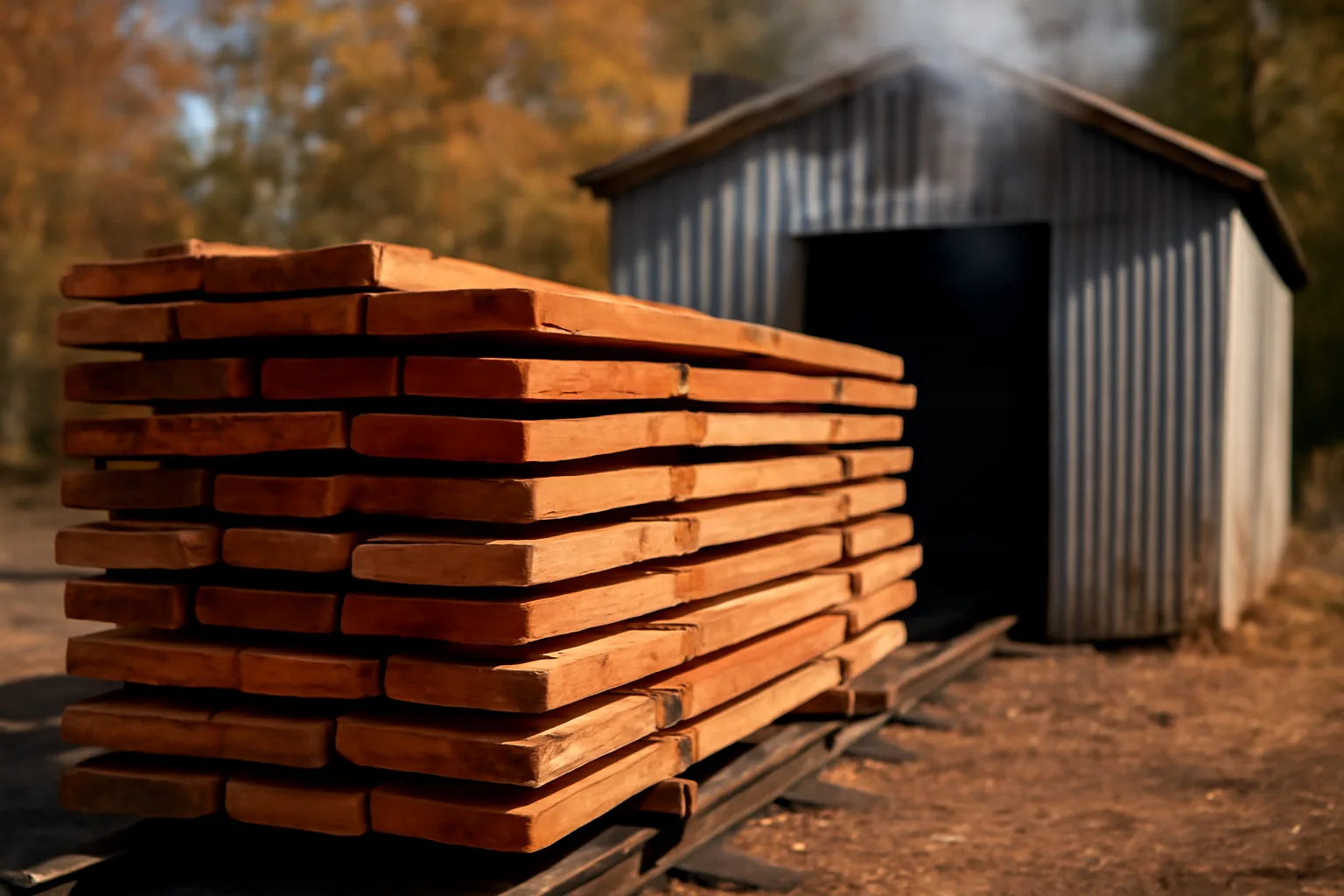
Kiln firewood is split firewood that spent time in a heated chamber until it is dry enough to burn clean and, in many states, hot enough at the core to kill insects. That is the product. It is not a federal grade, and the word kiln on a bag does not by itself make the load legal to move.
Air-dried wood sits in a rick and waits on weather. Kiln wood is forced. The U.S. EPA tells households to burn dry wood, and its Burn Wise guidance is blunt: burners should use wood at 20% moisture content or less [1]. Kiln operators chase that number because wet wood steals heat and makes smoke. Green hardwood often holds far more water. The USDA Forest Products Laboratory Wood Handbook treats moisture content as the weight of water divided by the oven-dry weight of the wood, and green sapwood of many species sits well above 60% on that scale [4].
People mash three different products into one phrase. Seasoned wood is air-dried. Kiln-dried wood was heated in a box until a meter hits a target. Heat-treated wood hit a time-and-temperature kill schedule, which may or may not leave it at 20%. You can sterilize a charge and still sell soggy stove wood. You can dry to 15% and still lack the certificate a state wants at the border.
If you sell to campgrounds, big lots, or anyone who ships, buyers care about the paper as much as the steam. If you sell two face cords off a farm lane, they care that it lights. Price those jobs differently. Do not print certified on a pallet wrap unless a named board actually certified that charge.
How do you start kiln firewood?
You start by treating kiln firewood as a small commodity business, not a weekend hobby with a logo. Register the business locally, get a sales tax permit if your state taxes firewood, and call weights and measures about selling by the cord. Then decide whether loads stay in-county or cross a state line. That one choice decides whether you need a plant-board treatment certificate.
I would not buy a big gas kiln in month one. Rent time on someone else's chamber, or start with a small dehumidification box you can fill from one cutting week, until orders and species mix are real. Parallel path: source logs you have a right to cut, split to a consistent length (16 inches is the usual stove length, ask your buyers), sticker the piles so air moves, and log every charge with date, species, start moisture, peak temperature, and end moisture.
There is no USDA kiln firewood license that covers the country. APHIS dropped the federal emerald ash borer domestic quarantine in a 2020 final rule, writing that it was "amending its regulations to remove the domestic quarantine regulations for the emerald ash borer (EAB)" [6]. States kept their own firewood rules. Maine still restricts imported untreated firewood [8]. California's CDFA publishes interior exclusion rules for firewood [9]. New York still treats untreated firewood as a pest pathway and publishes a heat schedule [10].
Paper you will actually be asked for is boring and specific. A delivery ticket that states quantity in a legal unit. A moisture reading if you advertised kiln-dried. A treatment certificate if you crossed a line a plant board cares about. Minnesota requires a retail firewood seller to give a delivery ticket or invoice with the facts of the sale [7]. Steal that habit even if you do not live there.
If you want one folder for moisture logs, cord math, and HOA letters, FirewoodPath sells a $129 one-time Moisture + Cord + HOA Kit at /start. You do not need it to follow this guide.
What moisture content makes firewood kiln-dried?
There is no single federal moisture number that turns a stick into kiln firewood. The number buyers and agencies actually repeat is 20%. EPA Burn Wise tells people to burn wood at 20% moisture content or less [1]. University of Minnesota Extension likewise treats well-seasoned firewood as wood that has dried enough to burn clean, and it walks buyers through storage so that dry wood stays dry [3].
I would sell kiln firewood only after a pin or pinless meter reads 20% or under on several pieces from the middle of the charge, more than the top layer. Take more than one reading. Ends lie. Fresh-split faces lie less.
Kiln-dried lumber for furniture is a different product. Hardwood furniture stock is often taken much drier, commonly into the single digits, because indoor air will keep pulling water out [4]. Firewood does not need that. Chasing 6% in stove wood is wasted kiln time and extra breakage. You want wood that lights, meets the claim on the invoice, and does not grow mold in the bag.
Air-drying still matters as a cheap first stage. Penn State Extension puts ordinary seasoning in a 6 to 12 month window for many species, in a stack off the ground with sun and wind [2]. A kiln is what you add when you cannot wait a year, or when a buyer wants a dated heat ticket. If your starting moisture is still near green, your cycle gets long and your fuel bill gets stupid. Split first. Sticker. Then heat.
Is kiln-dried the same as heat-treated firewood?
No. Kiln-dried describes moisture. Heat-treated describes a pest-kill schedule. They can happen in the same box. They are not the same claim, and mixing them on a label is how you pick a fight with a plant inspector.
A dehumidification kiln can drop a charge to 18% without ever proving the core sat at a published kill temperature for the required time. A steam or gas sterilization cycle can hit a published core temperature and still leave the load above 25% moisture if you pull it early. Read your state's actual words. New York's firewood page is built around treated versus untreated wood and a stated heat schedule, not around a brand name on a kiln [10]. Michigan's firewood guidance is likewise about not moving pests, with heat-treated or locally sourced wood as the usual answers [11].
ISPM 15 is the international heat standard for wood packaging, not a firewood grade. It calls for a minimum wood core temperature of 56°C for 30 continuous minutes [12]. Some firewood programs use that schedule. Some use hotter and longer. Do not stamp HT on a bag because you once read ISPM 15. Stamp what the receiving board wrote down.
If a campground or state park says certified heat-treated, ask which certificate and which lab or inspector they mean. Then run that schedule and keep the chart. Moisture photos do not replace a temperature log when the rule is about bugs.
Do you need a license to sell kiln firewood?
You need local business permission and whatever your state uses for retail sales. You do not need a mythical national kiln firewood license. Confirm every fee and form with the office that issues it. Nobody honest publishes one number that works in all 50 states, and processing times move.
Typical paper, in plain language: a county or city business license if they require one, a state sales tax permit if firewood is taxable, and a weights and measures conversation about selling by the cord or another legal method of sale. Minnesota puts the retail ticket duty in statute [7]. Other states bury the same idea in their weights codes. Call them before you print a price list that says rick or truckload as if those were legal units.
Plant-board certification is a separate pile of paper. You need it when you advertise treated wood for movement, or when you ship into a state that blocks untreated imports. Maine restricts imported untreated firewood [8]. Vermont's plant health page tells people not to bring untreated firewood into the state [14]. California's CDFA firewood page is the place to read that state's interior rules [9]. Those are movement rules, not a permission slip to own a chainsaw.
I would not pay a consultant to package a federal license that does not exist. I would walk into the county clerk, the state revenue site, and the plant board, in that order, and write down the real form names. If a vendor promises they can get you USDA certified firewood status for the whole country, hang up.
How do you measure a cord of kiln firewood?
A standard cord is 128 cubic feet of stacked wood. Penn State Extension states it as a stack 4 feet high, 4 feet wide, and 8 feet long [2]. That stacked volume includes the air gaps. It is not 128 cubic feet of solid wood. Kiln-dried pieces shrink, so a kiln charge that looked like a cord going in can look short coming out. Sell the stacked measure you actually deliver, not the green volume you remember.
Face cords, ricks, truckloads, and scoops are where new sellers get complaints. A face cord is usually an 8-foot by 4-foot face with the piece length as the depth, so a 16-inch face cord is a third of a full cord. Say that in writing. If you sell bags, state the bag size and how many bags you claim make a cord, and be ready to restack.
Minnesota's retail firewood statute is a good model even outside Minnesota: give a delivery ticket or invoice that identifies the seller and the quantity [7]. Put species if you claimed a species. Put kiln-dried only if you metered it. I would refuse to take a phone order for a cord thrown in the truck. Stack it, photograph the stack against a tape, and keep the photo with the ticket.
Do not invent a kiln cord. Buyers already think they were shorted. Your job is to make the math boring.
What kiln and yard gear do you need in year one?
You need a way to split to length, a way to move air through a stack, a chamber that can hold a documented temperature, a moisture meter you trust, and a temperature recorder that will still make sense six months later. That is the kit. Fancy scada screens can wait.
The USDA Forest Products Laboratory's hardwood drying handbook is written for lumber, not camp wood, but the physics is the same: heat, humidity control, and airflow decide whether the core dries or the shell case-hardens [5]. Firewood is more forgiving than 4/4 oak boards. You still need stickers, baffles, and a fan that actually moves air through the middle of the load. A sealed box with a heater and no airflow is a mold farm.
Safety is not optional once you run fans and dust. OSHA lists wood dust among air contaminants in 29 CFR 1910.1000, and a kiln shed will make dust [13]. I would put in basic dust discipline and keep ignition sources off the top of a dry charge. I would not build a homemade gas burner inside a container unless you already know combustion air and shutoffs. Hire that or buy a unit built for it.
Waste of money in year one: a kiln bigger than your weekly split volume, a wrapping line, and custom bags with a Latin species list. Useful: Pallet jack, extra stickers, two meters (so you can see when one drifts), and a cheap data logger. Used shipping-container dehumidification units show up in farm ads across a wide price spread. I will not quote a number that will be wrong next month. Get three quotes and size to the wood you already have under contract.
Can you haul kiln firewood across state lines?
Sometimes, if the receiving state accepts your treatment paper. Never assume a kiln receipt from your home county is a passport. The federal EAB quarantine is gone [6]. State rules are not.
Maine tells importers that untreated firewood is restricted [8]. Vermont's plant health program tells the public not to bring untreated firewood into Vermont [14]. California posts firewood exclusion guidance through CDFA [9]. New York's firewood rules still treat long-distance untreated wood as a pest problem and describe treated wood in heat terms [10]. Michigan's firewood page is written around stopping pest movement, with local or treated wood as the usual fix [11].
Call the destination plant board before the truck moves. Ask three questions. Do they accept kiln-dried to 20% as treated, or do they want a named heat schedule? Do they need an inspection, a compliance agreement, or only a shipper statement? Do parks and private campgrounds in that state use a tighter rule than the state line?
I would not build a multi-state brand in year one. Sell inside a tight radius until a buyer who pays on time asks you to cross a line, then get that one corridor in writing. Crossing three states with mixed certificates is how a cheap load becomes an expensive return.
What paper do inspectors, HOAs, and buyers ask for?
They ask for proof of quantity, proof of dryness if you claimed it, and proof of treatment if the wood moved. That is the set. Keep it in one binder per month, paper and phone photos.
Quantity paper is the delivery ticket. Minnesota writes that duty into statute for retail firewood [7]. Copy the idea: seller name, address, date, quantity in cords or another legal unit, price, and a line for species if you sold it as oak or maple. HOAs and gated lots often want the same ticket plus a statement that you will not dump chips in the cul-de-sac. Write the dump rule on the ticket so your driver cannot freelance.
Dryness paper is the meter log. Species, charge ID, date in, date out, three or more moisture readings, meter model. EPA's 20% figure is what most picky buyers repeat [1]. If you advertised 15%, you now owe 15%.
Treatment paper is whatever the destination board prints. It might be a phytosanitary certificate, a compliance-agreement number, or a heat chart signed by the operator. New York and several other states care about a temperature-and-time story, not a brand of kiln [10]. Parks may want a printed tag on each bundle. Ask before you wrap 400 bags with the wrong sentence.
I would keep charge logs for at least a year. Longer if you sell to retailers. When a complaint comes in February about a December bag, the log is the whole defense.
How long does a kiln cycle take?
Hours to a few days for already split, partly dry wood. Longer if you load green rounds and hope. Nobody has one official firewood kiln schedule that every species obeys. The closest serious manuals are lumber drying handbooks, and they are built for boards, not 16-inch splits [5].
Starting moisture dominates. Penn State Extension's 6 to 12 month air-dry window is the cheap way to knock water out before you pay to heat it [2]. A charge that already sits near 30% behaves. A charge of fresh oak at high moisture will run long, and the shell can dry while the core stays wet if you rush the heat.
Heat-treatment schedules are shorter than full drying schedules when the only goal is a core temperature. ISPM 15's 56°C for 30 minutes is a core hold, not a dryness claim [12]. New York's published firewood heat language is hotter and longer than that packaging standard [10]. Run the schedule you need for the claim you print. Then keep drying if the meter is still high.
I would instrument the center of the load, not the air near the heater. Air temperature lies. A cheap probe in a drilled piece in the middle of the stack is more honest. If you cannot show a core curve, you do not have a treatment record. You have a warm shed.
What first-year spending is a waste of money?
A kiln that is bigger than your weekly split volume is the usual hole. So is custom retail packaging before you have repeat buyers, a wrapped delivery truck, and any software that promises to unlock routing for a two-county firewood route. Buy used handling gear. Rent chamber time until the calendar is full.
Paying someone for a national certification package is also a waste. The federal EAB domestic quarantine is gone [6]. What remains is state-by-state. Spend the money on phone calls to the boards you will actually touch, and on a meter you will use every charge.
I would spend on wood you have a clear right to cut, on splitting capacity, and on a logger who shows up. I would not spend on a second species line, birch bundles with printed sleeves, or a storefront. Kiln firewood is a truck and a ticket business in year one.
Insurance is not a waste if you deliver. A loaded trailer and a driveway claim will cost more than a small commercial policy. Ask your agent about fire during kiln operation. Some farm policies go quiet when you add a heated chamber. Get that answer in email.
How do you confirm kiln firewood rules in your state?
You call two offices and you write down the form names. The plant board (sometimes agriculture, sometimes natural resources, sometimes a pest program) owns movement and treatment. Weights and measures owns how you may sell a cord. County clerks own the basic business license. Confirm fees and wait times with them. Do not trust a blog, including this one, for a current dollar figure.
State pages disagree with each other on purpose. Maine's imported firewood page is a hard border story [8]. California's CDFA firewood page is an interior exclusion story [9]. New York's firewood page is a distance-plus-treatment story [10]. Michigan's page is a pest-pathway story aimed at the public and at movers [11]. Vermont's plant health firewood page is a do-not-bring-it story [14]. Read the one that matches the destination, not the one that matches your marketing.
Board write-ups on this site are a starting map, not a substitute for the statute. If you are comparing how different states talk about kiln paper, see the kiln firewood board in alabama, kiln firewood board in arizona, kiln firewood board in california, kiln firewood board in colorado, kiln firewood board in florida, kiln firewood board in georgia, kiln firewood board in idaho, and kiln firewood board in connecticut. Then open the live .gov page those write-ups point at.
FirewoodPath is an independent publisher, not a law firm and not a service company. No article here can approve a kiln, promise a processing time, or stand in for the board that will stop a truck. If a fact can change (fees, quotas, forms), confirm it with that board before you print a label.
Frequently asked questions
What is kiln firewood?
Kiln firewood is split firewood dried in a heated chamber so moisture falls, usually to 20% or less, which is the figure EPA Burn Wise gives households. Some loads are also run on a pest-kill heat schedule. Kiln-dried is a moisture claim. Heat-treated is a temperature-and-time claim. They are not automatic synonyms, and neither one is a federal grade.
How do you start kiln firewood?
Register the local business, sort sales tax, and call weights and measures about selling by the cord. Source wood you have a right to cut, split it, and run charges you can log (moisture, temperature, dates). Stay in-state until a paying buyer needs a crossing. There is no national kiln firewood license. Confirm plant-board treatment rules before you advertise certified wood.
Does kiln drying kill emerald ash borer and other insects?
Only if the core hits the time and temperature your destination board wrote down. Drying to 20% moisture is not, by itself, proof of a kill. APHIS removed the federal EAB domestic quarantine in 2020, so you follow state schedules now. ISPM 15's 56°C for 30 minutes is a packaging standard some programs borrow. Ask the receiving board which curve they accept.
Can I sell firewood without a kiln?
Yes. Most household wood in the country is still air-dried. Penn State Extension puts ordinary seasoning in a 6 to 12 month window. You can sell seasoned wood locally if you measure it legally and do not claim kiln-dried or certified treated. A kiln becomes worth it when buyers pay for speed, a moisture promise, or a movement certificate you cannot get from a rick in the wind.
What moisture meter do I need?
A wood meter you can check against another meter, used on fresh-split faces from the middle of the charge. Pin or pinless both work if you learn the species setting and you stop trusting end-grain. I would own two cheap meters before one fancy one. Log the model with the reading. If you printed 20% on the bag, the middle of the pile has to support that number.
Do I need USDA certification for kiln firewood?
Not as a blanket national product license. APHIS ended the federal EAB domestic quarantine in the December 2020 final rule. Some shipments still need federal phytosanitary paper for export or for a specific pest program. Most domestic kiln firewood questions now sit with state plant boards. Ask the destination state what document, if any, they want. Do not buy a fake USDA kiln stamp.
How should I label kiln firewood on the invoice?
Seller name, date, quantity in a legal unit (almost always the cord or a stated fraction), price, and only the claims you can prove. Write kiln-dried if you metered it. Write heat-treated only with the schedule and the board in mind. Minnesota's retail ticket rule is a clean model. Do not use rick or truckload as if they were defined units unless you also state the cubic feet.
Can I run a firewood kiln on residential property?
Only if zoning, the fire marshal, and your insurer say yes. A heated chamber, a fan, and a dry wood pile are a fire and a nuisance case waiting on a neighbor. Confirm setbacks, fuel storage, and hours. HOAs often ban commercial traffic even when the county does not. Get the answer in writing before you pour a slab. I would not hide a container kiln behind a garage and hope.
What species kiln-dry fastest?
Softwoods and ring-porous woods with a head start on air-drying usually give up water faster than dense green oak. That is a shop observation, not a federal table. The Forest Products Laboratory drying handbook is about lumber schedules, and those schedules already show species differ a lot. Split small, start drier, and stop promising next-day oak from fresh logs.
Is kiln firewood worth a higher price?
It is worth more when the buyer cannot wait 6 to 12 months, wants a 20% moisture promise, or must show treatment paper at a gate. It is not worth more if you are selling the same wet pile with a new adjective. Price the documented service. If your only edge is a logo, you will lose to the next person with a splitter and a sunny fence line.
Do campgrounds require certified heat-treated wood?
Many public parks and a lot of private campgrounds do, especially where a state already blocks untreated imports. The certificate they want is whatever that park system or state plant board named, not a generic kiln receipt. Call the park. Michigan, Maine, Vermont, New York, and California all publish some version of do not move untreated wood. Local wood is the other accepted answer.
What records should I keep for each kiln charge?
Charge ID, species mix, date and time in, date and time out, start moisture, end moisture, core temperature curve if you claim treatment, and where the load went. Keep the delivery ticket copy. Photograph the stacked measure. Hold the file at least a year. Retail buyers and inspectors both show up late. A binder beats a memory.
Does a dehumidifier kiln count as heat treatment?
Only if that run actually hit the destination board's core temperature and hold time, and you recorded it. Many dehumidifier kilns dry well and never reach a published kill schedule. Moisture at 18% is a dryness claim. A 56°C or 160°F core hold is a treatment claim. Read the receiving rule. Do not treat the equipment catalog as the law.
Who do I call if I want to ship kiln firewood to another state?
Call the destination state's plant board or agriculture pest program first, then your own state's exporter or compliance-agreement staff if they have one. Ask what treatment they accept, what form they want, and whether parks use a tighter rule. Confirm any fee with them. Then call weights and measures in the destination state if you will sell retail there. Do not move the truck on a vendor's say-so.
Sources
- U.S. EPA, Best Wood Burning Practices (Burn Wise): EPA advises burning dry, seasoned wood at 20% moisture content or less.
- USDA Forest Products Laboratory, Wood Handbook (FPL-GTR-190): Moisture content is mass of water over oven-dry mass; green sapwood of many species exceeds 60%.
- USDA Forest Products Laboratory, Drying Hardwood Lumber (FPL-GTR-118): Kiln drying depends on heat, humidity control, and airflow; published schedules are species-specific and written for lumber.
- Federal Register, Removal of Emerald Ash Borer Domestic Quarantine Regulations (2020-26734): APHIS amended its regulations to remove the domestic quarantine regulations for emerald ash borer.
- Minnesota Statutes 239.092, Sale of firewood: A person who sells firewood at retail must provide a delivery ticket or invoice with the facts of the sale.
- California Department of Food and Agriculture, Firewood: CDFA publishes interior exclusion and movement rules for firewood in California.
- IPPC, ISPM 15 Regulation of wood packaging material in international trade: ISPM 15 heat treatment requires a minimum wood core temperature of 56°C for 30 continuous minutes.
- OSHA, 29 CFR 1910.1000 Air contaminants: Wood dust is listed among air contaminants regulated under OSHA's air contaminants table.