Last updated 2026-08-21
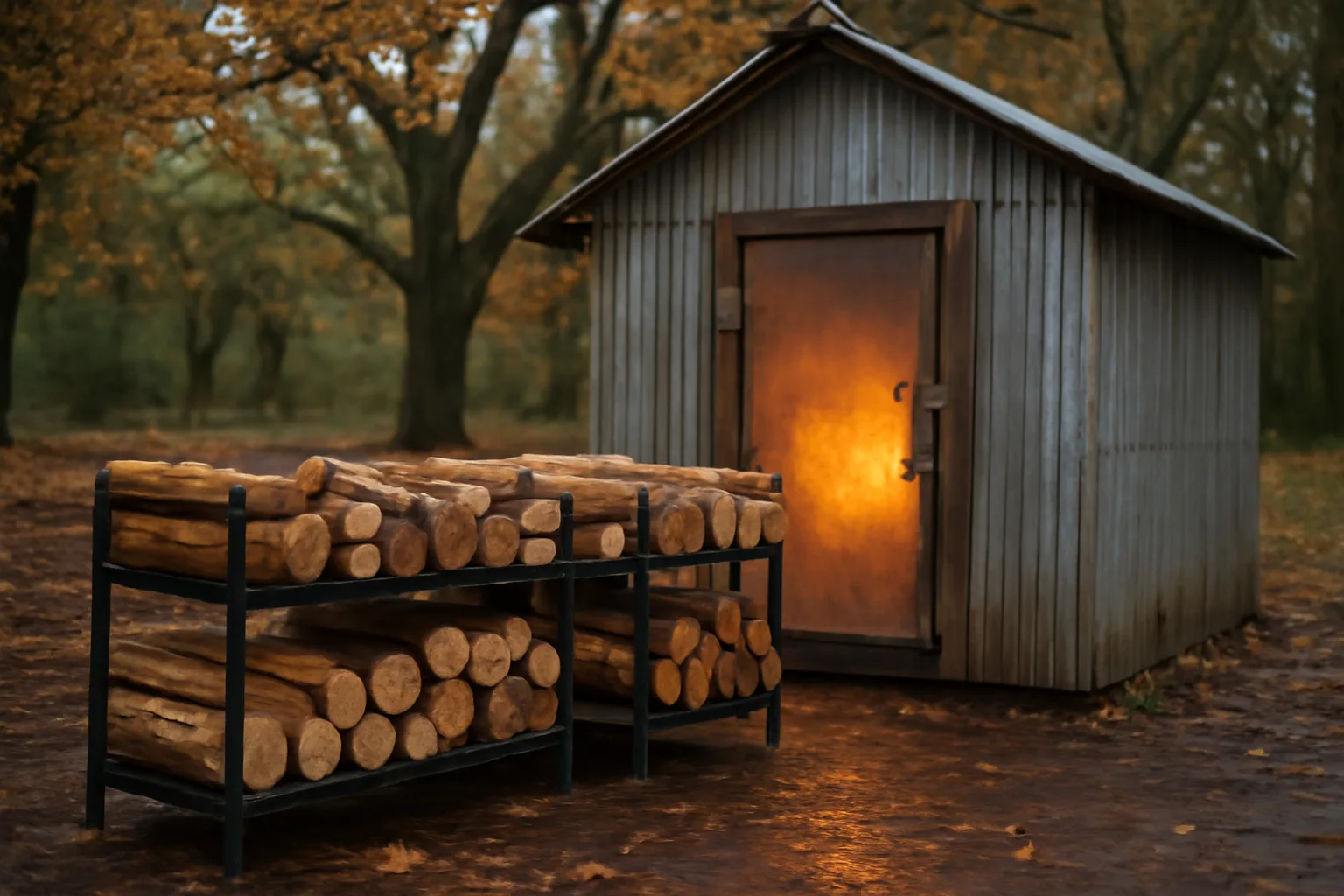
TL;DR
Kiln firewood is split wood dried in a heated chamber, usually to about 20% moisture or less. You start by picking a business form, confirming zoning plus any air or weights-and-measures rules, then running a kiln you can control. There is no national license. Confirm every form with the board that issues it. Heat and a written moisture record matter more than a logo on a bag.
What is kiln firewood?
Kiln firewood is split wood that spent time in a heated chamber until the water in the wood dropped. Most sellers aim for about 20% moisture or less, the same dryness EPA tells households to burn. [1][2] It is not air-piled wood with a premium name. The kiln is what you are selling.
People mix three products and then argue online. Seasoned wood dried outside. Kiln-dried wood brought down by controlled heat. Heat-treated wood held at a pest-kill temperature for a set time. You can do the last two in one run if you design the schedule that way. You can also dry wood in a kiln and still fail a phytosanitary check if you never hit the core temperature the destination state wants.
EPA puts the burn target in plain language on its Burn Wise pages and ties dry household wood to a 20% moisture content. [1][2] That number is consumer smoke guidance, not a federal kiln license. Still, if you print kiln dried on a wrap and the sticks read 28% on a pin meter, you have a complaint waiting.
I treat kiln firewood as a measured product. Species, piece length, a moisture range you will defend, and a stack that actually fills a cord. The Forest Products Laboratory Wood Handbook is the boring book I go back to when someone argues about what moisture content even means. In that handbook, "Moisture content is defined as the weight of water in wood expressed as a percentage of the weight of ovendry wood." [4]
If you only remember one line, remember this. Kiln firewood is heat plus a number you can show.
| Product | What you actually did | Moisture story | Pest claim you can defend |
|---|---|---|---|
| Seasoned pile | Sat in air | Often heading toward 20% after a long dry spell | Usually none |
| Kiln-dried | Heat and airflow in a chamber | You set a target and meter it | Only if you also hit a treatment schedule |
| Heat-treated | Core held at a kill temperature for a time | Often dry, not automatically dry | Only with a logged schedule |
How do you start kiln firewood?
You start kiln firewood by locking four things before you advertise a cord. A legal person (you, an LLC, or a corporation). A site that can take heat, trucks, and a wood pile under local zoning. A kiln you can log. A sales method that matches your state's weights and measures rules.
There is no federal kiln-firewood operator card. USDA and APHIS care about pests and treatments when wood moves. [14] Your secretary of state, tax department, and weights and measures office care about the business. Your county cares about the land. I would form the entity and call zoning in week one. I would not order a kiln until someone in planning says the use is allowed, or tells you the variance path.
On paper, first-year work looks like this. Get an EIN if you want a bank account that is not your social security number, or if you will have employees. [8] Pick a structure using the same choices every other small firm uses. [9] Register to collect sales tax if your state taxes firewood. Some states exempt wood sold for home heating. Confirm that. Ask the state metrology or agriculture department how firewood must be sold. Then look at plant-industry rules if you will label wood as heat treated.
State paths differ. Alabama is not California. If you already know the state, skip the national myth and open the local start page, like how to start kiln firewood in Alabama or how to start kiln firewood in California.
Do not wait for a blog to tell you the fee. Confirm the current application and any fee with the board that takes the form. Nobody honest guarantees approval time.
What moisture content makes firewood kiln-dried?
Kiln-dried firewood is wood whose moisture you drove down with a kiln, commonly to 20% or less. There is no single federal statute that says kiln firewood equals 18%. The 20% figure comes from burn guidance and trade custom. Measure it. Write it down.
EPA uses that 20% line for dry household firewood on more than one Burn Wise page. [1][2] Extension pages that teach people how to buy and store wood live in the same neighborhood of numbers. [5][7] Those pages are written for stoves and smoke, not for your invoice. They still set the expectation your customer already has.
Pin meters are what you will actually use. Oven-dry testing is the lab method behind the Wood Handbook definition. [4] Nobody in a driveway ovendries every stick. A decent pin meter, a sample plan (ends and centers, several pieces per charge), and a refusal to ship wet cores. That is the job.
I would not print a moisture number you did not measure that week. Wood picks water back up in rain. Kiln-dry is a condition, not a baptism. If a wrapped crate sits in a puddle, you own that reading.
What heat treatment do pest rules actually use?
Pest rules care about temperature at the core, not your marketing word. A 2009 Journal of Economic Entomology study on emerald ash borer put the conclusion this way: "Our results indicate that holding wood at 60 degrees C for 30 min should provide a conservative approach for ensuring mortality of EAB." [10] That is 140 F, held.
USDA phytosanitary treatment rules live in 7 CFR Part 305 and in the APHIS treatment schedules those rules point to. [12] Operational schedules you will hear on the yard are often 60 C (140 F) for 60 minutes. That hold is longer than the 30 minutes in the 2009 paper. If you will sell wood as treated for interstate or state quarantine use, confirm the current schedule with APHIS and the destination state. Do not guess from a forum post.
Heat-treated is not automatically dry enough to burn clean. You can hit a kill temp and still be above 20% in a thick round if you rushed. Run the dry and the hold as two checks. Log both.
I would put a sensor in the thickest piece in the worst corner of the charge. Edge air is a vanity reading. Core wood is the reading an inspector cares about.
How do you measure a cord of kiln firewood?
You sell wood by volume unless your state says otherwise. NIST Handbook 130 is the model law most weights and measures offices copy. A cord is 128 cubic feet of wood, ranked and well stowed. [3] Penn State and Michigan State both walk buyers and sellers through that stack. [5][6]
A face cord is not a cord. A truckload is not a cord. If you sell half a cord, the stack should occupy 64 cubic feet as ranked wood, not as a fluffy pile of air. Kiln-dried wood is often lighter than green wood. Customers notice the weight and sometimes accuse you of a short cord. Volume is the legal story. Keep the tape out.
I would keep a photo of every delivery against a known rack. When a customer calls the sealer of weights and measures, that photo is your friend.
| Amount you sold | Ranked volume you owe |
|---|---|
| 1 cord | 128 cubic feet |
| 1/2 cord | 64 cubic feet |
| 1/4 cord | 32 cubic feet |
| Face cord | Not a legal cord. Define the stack in writing. |
What licenses and tax paper do you need?
You need whatever your state requires to be a business that sells a measured commodity, plus any plant or agriculture registration if you claim heat treatment. Typical paper is an entity filing, a sales tax account if the sale is taxable, and a weights and measures review. Some cities want a home-occupation permit. Some air districts care about a commercial kiln. Confirm each item with the office that issues it. [8][9]
See kiln firewood license in Alabama and kiln firewood license in California for how different two states can look. Alaska is its own world on freight, land, and agencies. Start with kiln firewood license in Alaska if that is your map.
I am not going to invent a dollar figure for a license. Boards change fees. Call them. An EIN from IRS is free if you apply on the IRS EIN page. [8] That is one of the few numbers I will state without a hedge.
If you hire anyone, payroll tax and workers compensation enter the chat. Sole props with no employees still need to know how their state treats a wood yard next to a house. Ask, in writing.
What kiln equipment is worth buying in year one?
Year one I would buy a moisture meter I trust, a kiln I can hold at a set temperature, a saw and splitter I already understand, racks that keep wood off soil, and a way to log charges. A notebook is fine. I would not buy automated bagging, a custom brand-burn, or a kiln twice the size of my wood supply.
NCSU's kiln-drying guidance is written for lumber, and it still helps. Heat, airflow, and venting are the levers. [13] Firewood is less fussy than grade oak boards. It is more fussy than people think when the cores stay wet.
Waste of money: a huge kiln you cannot fill. A half-empty box wastes fuel and gives uneven charges. Match chamber size to the wood you can process in a week. Container kilns and dehumidification kilns both work. Solar kilns work in some climates and stall in others. Pick the one you can repair without a factory tech.
I would spend on sensors before I spend on paint. A cheap chamber with a logged core reading beats a pretty shed you cannot defend.
How long does it take to kiln dry a load?
Drying time depends on species, starting moisture, thickness, how hard you run the kiln, and how packed the charge is. The Wood Handbook will not give you one firewood hour count, and neither will I. [4] Thin split oak from a dead standing tree can be done in days in a hot kiln. Green rounds the size of a bucket can take much longer and still hide wet hearts.
Pine usually lets go of water faster than dense oak. That is ordinary wood behavior, not a promise. Starting moisture swings more than species sometimes. Winter-cut wood and summer-cut wood do not enter the box as equals.
I time the first ten charges with a meter, not a calendar. Then I use those notes. Anyone selling you 24 hours, every species, every month is selling hope. Write your own schedule from your own sticks.
Can you haul kiln firewood across state lines?
You can haul it if the destination state lets that load in, and if you can prove whatever treatment or origin rule they wrote. Moving firewood moves insects and fungi. APHIS tells people not to move firewood, and states layer their own rules on top. [14] Wisconsin, for example, limits what firewood can enter DNR lands and pushes certified or treated sources. [11]
Heat treatment plus a certificate is how commercial shippers usually satisfy a treated-wood rule. The certificate is only as good as the logged charge. Keep the sensor printout. Local sales inside one county are simpler. Stay local in year one unless you already know the receiving state's form.
Call the destination department of agriculture before you take a deposit on a cross-border load. Confirm the current rule. Rules change, and a blog post is not a permit.
What will first-year kiln firewood actually cost?
Nobody publishes a clean national number for first-year kiln firewood capital. Land and a building dominate if you do not already have them. A used chamber, burners or electric service, saws, a splitter, racks, insurance, and fuel come next. License fees are real and small next to a kiln, and they are set by boards, not by articles. Confirm them.
For a state-level cost walk-through, use a local page such as kiln firewood cost in Alabama. Alaska costs differently because freight and fuel are different. See how to start kiln firewood in Alaska.
I would budget the boring line items people skip. Insurance. A legal stack yard. A backup moisture meter. Road base so January is not a mud tax. Fancy bags can wait until you can repeat a moisture number.
Can zoning or an HOA stop a backyard kiln?
Yes. A kiln is heat, noise, trucks, and a woodpile. Zoning bylaws and covenants care about those even when the state agriculture office does not. Read the use table. Call the planner. If you live under an HOA, read the CC&Rs for home business, outdoor storage, and nuisance clauses before you pour a pad.
Some associations will fight smoke and commercial traffic. I would get written confirmation, or I would rent industrial land. Fighting a board after the kiln is built is a bad use of winter.
If you want moisture, cord language, and HOA covenant prompts in one packet, FirewoodPath sells a $129 one-time Moisture + Cord + HOA Kit. You can ignore that and still follow every step in this guide.
Colorado towns can be picky about smoke and home businesses. If that is your map, read how to start kiln firewood in Colorado.
How should you label and price kiln firewood?
Price from your cost per sellable cord after kiln loss, not from a Facebook screenshot. Kiln-dried often sells at a premium to green or vaguely seasoned wood because it is lighter, cleaner, and ready. How much premium is local. I would rather be the reliable half-cord shop than the cheapest full cord of mystery moisture.
Label what you can prove. Species if you sorted it. A moisture range from the charge log. Heat-treated only if you held the schedule. The word cord only if the volume is 128 cubic feet ranked. [3][6] Do not call a face cord a cord.
For the state paper path, open the guide that matches your yard. FirewoodPath keeps those start pages as an independent publisher, not as your lawyer and not as a service company. The checklist kit is at /start if you want that bundle.
Frequently asked questions
What is kiln firewood?
Kiln firewood is split wood dried in a heated chamber until you can defend a moisture number, commonly about 20% or less. It is a process claim, not a species. Heat-treated wood is a separate pest claim that needs a logged core temperature and hold time. You can do both in one charge if you plan it.
How do you start kiln firewood?
Form a legal business, confirm zoning and any air or home-occupation rules, then set up a kiln you can log and a sales method that matches weights and measures. Get an EIN if you want one or have staff. There is no national operator license. Confirm every form and fee with the board that issues it.
Is kiln-dried firewood the same as heat-treated firewood?
No. Kiln-dried means you lowered moisture with a kiln. Heat-treated means you held the core at a kill temperature for a required time. A dry charge can miss the pest hold. A treated charge can still be too wet to burn clean. Run both checks if you sell both words.
Do you need a license to sell kiln firewood from home?
Often you need business registration, a sales tax account if the sale is taxable, and whatever your sealer of weights and measures requires to sell by the cord. Some towns add a home-occupation permit. Some states add a plant-industry listing if you claim treatment. Confirm with those offices. Do not trust a national checklist for the fee.
What moisture content should kiln firewood be?
Aim for about 20% or less if you sell to people who burn it in a stove. EPA uses that 20% line on its Burn Wise pages. No federal kiln statute locks a single percent for the word kiln-dried. Meter several pieces per charge, including cores, and only print a number you measured.
How hot does a firewood kiln need to get?
For dryness, hot enough to move water out of the core without wrecking the charge. For pest claims, operators often talk about 140 F (60 C) held at the core. A 2009 Journal of Economic Entomology paper found 60 C for 30 minutes conservative for emerald ash borer. Confirm any official schedule with APHIS and the destination state.
How long does kiln drying firewood take?
It depends on species, starting moisture, stick size, and how you run the box. Thin, already dry splits can finish in days. Green, thick rounds can take much longer and still hide wet hearts. Nobody has one honest national hour count. Time your first charges with a meter and keep those notes.
Can you sell kiln firewood by the face cord?
You can sell a defined stack if your state lets you, but a face cord is not a cord. A cord is 128 cubic feet ranked and well stowed under NIST Handbook 130 style rules. If you use face cord, write the exact pile size on the invoice so a sealer can reconstruct it.
Does the USDA require a permit just to dry firewood?
No. Drying wood for local sale is not, by itself, a USDA license. APHIS and 7 CFR Part 305 matter when you make phytosanitary treatment claims or move regulated articles. Interstate loads and treated-wood certificates are where federal plant rules show up. Confirm the current case with APHIS if you will ship.
Can you take kiln firewood across state lines?
Only if the destination state allows that origin and treatment. APHIS tells people not to move firewood because pests ride along. States add their own bans and certified-wood lists. Call the destination agriculture department before you take money. Keep the kiln log if you claim a heat treatment.
What insurance do kiln firewood sellers carry?
I would talk to a broker who already writes wood yards, not a nameless internet package. Commercial general liability is the usual starting conversation. Add commercial auto if you deliver, and workers compensation if you have employees. Confirm limits and exclusions. This is not a quote and not advice from a carrier.
Is a solar kiln enough for commercial kiln firewood?
A solar kiln can dry wood you then meter and sell locally. It is a weak tool if you need a logged pest hold in cold, short days. I would use solar for extra dry capacity, not as my only box, unless my climate and my claims are both modest.
Do you need a phytosanitary certificate for local sales?
Usually no, if the wood never leaves the area your state treats as local and you are not making a quarantine treatment claim. Certificates show up when wood moves or when a buyer needs treated status. Confirm with your state plant office. Do not pay for paper you cannot use.
How do you prove a charge hit 140 F?
Put a sensor in the thickest piece in the worst location and keep the time-and-temperature record with the charge number. A wall thermostat is not proof. If a state or buyer wants a treatment certificate, ask them which log format they accept before you run the load.
Sources
- U.S. EPA, Best Wood Burning Practices (Burn Wise): EPA Burn Wise guidance tells households to burn dry, seasoned wood and ties that practice to low moisture firewood.
- NIST Handbook 130 (2024), Uniform Laws and Regulations in the Areas of Legal Metrology and Fuel Quality: Handbook 130 is the model method-of-sale text most states copy; a cord is 128 cubic feet of wood ranked and well stowed.
- USDA Forest Products Laboratory, Wood Handbook (FPL-GTR-190): Defines wood moisture content as the weight of water expressed as a percentage of ovendry wood weight and explains kiln drying behavior by species and thickness.
- Michigan State University Extension, Tips for buying and selling firewood: Sellers must follow weights and measures rules when advertising and delivering firewood volume.
- IRS, Apply for an Employer Identification Number (EIN) Online: An EIN is obtained through IRS and is required if you have employees; sole props may also get one for banking.
- U.S. Small Business Administration, Choose a business structure: Starting operators choose among sole proprietorship, partnership, LLC, and corporation under state law.
- Myers, Fraser, and Carey, Journal of Economic Entomology (2009), PubMed 20069830: Study conclusion that holding wood at 60 degrees C for 30 minutes should provide a conservative approach for ensuring mortality of emerald ash borer.
- Wisconsin DNR, Firewood restrictions: Wisconsin limits firewood that may enter DNR lands and directs people toward approved or treated sources.
- eCFR, 7 CFR Part 305 Phytosanitary Treatments: Federal phytosanitary treatment regulations that govern official treatment schedules APHIS uses for plant articles.